AI is no longer a niche specialty. It is the defining technology shift of this decade, and the demand for people who can build with it is accelerating faster than almost any skill set in the history of software engineering.
If you are a developer wondering what to learn next, a career changer looking to break into tech, or an engineer who wants to stay competitive -- this guide breaks down the AI skills that matter most in 2026, why they matter, and how to start learning them today.
The AI Job Market in 2026: What the Data Shows
The numbers tell a clear story:
- AI, ML, and data science job postings surged 163% from 2024 to 2025, with generative AI roles alone up 170% (Lightcast)
- AI engineer is the fastest-growing job title in tech, growing 13.1% quarter-over-quarter. Top hirers include Amazon, Apple, and TikTok (Veritone)
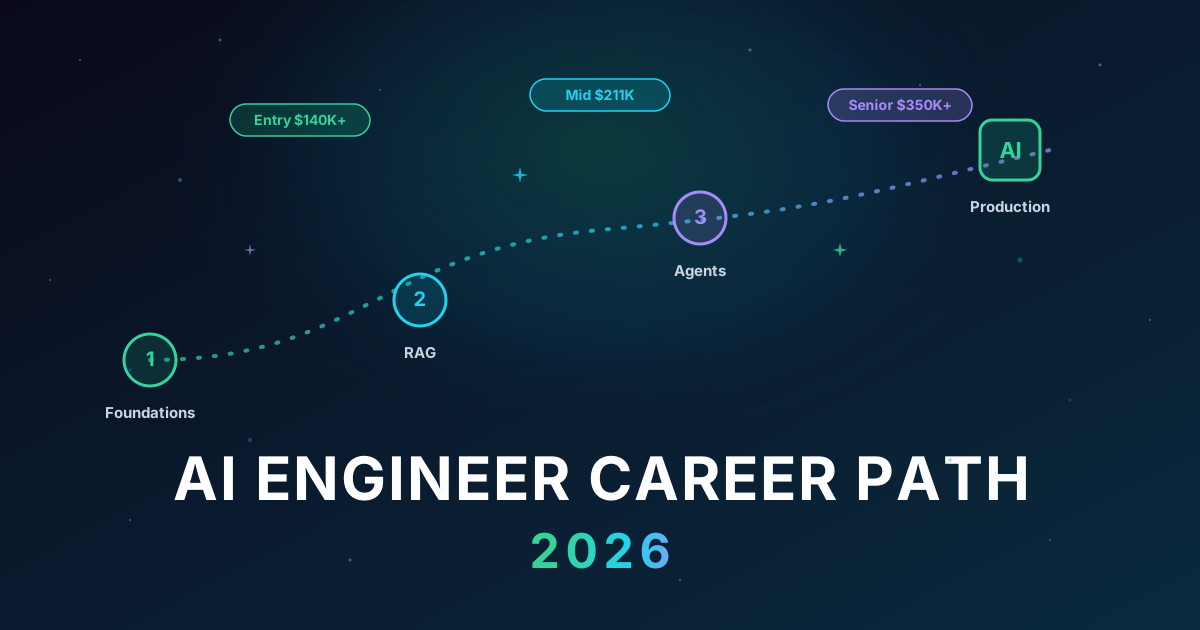
- The median salary for AI roles hit $156,998 in Q1 2025, with senior AI engineers averaging over $200,000 and specialists commanding 30-50% more than generalists (Second Talent)
- Job postings mentioning agentic AI skills jumped 986% between 2023 and 2024 -- and that trajectory is accelerating
- 88% of organizations now use AI in at least one business function, up from 78% a year earlier (McKinsey 2025). All Fortune 500 companies have integrated AI into operations
- Nearly 50% of employers struggle to find candidates with advanced AI skills -- creating a massive opportunity for anyone willing to learn (Burning Glass Institute)
- AI is expected to generate 6 million new positions globally in 2026, growing to 13 million per year by 2030 (ElectroIQ)
The takeaway is straightforward: learning AI skills is one of the highest-ROI investments you can make in your career right now. The demand far outpaces the supply of qualified candidates.
This Is Not Just for ML PhDs
The biggest misconception about AI careers is that you need a PhD in machine learning. The reality in 2026 is that most AI engineering work involves connecting pre-built components -- LLMs, APIs, vector databases, and frameworks -- not training models from scratch. If you can write code and are willing to learn, you can build AI applications.
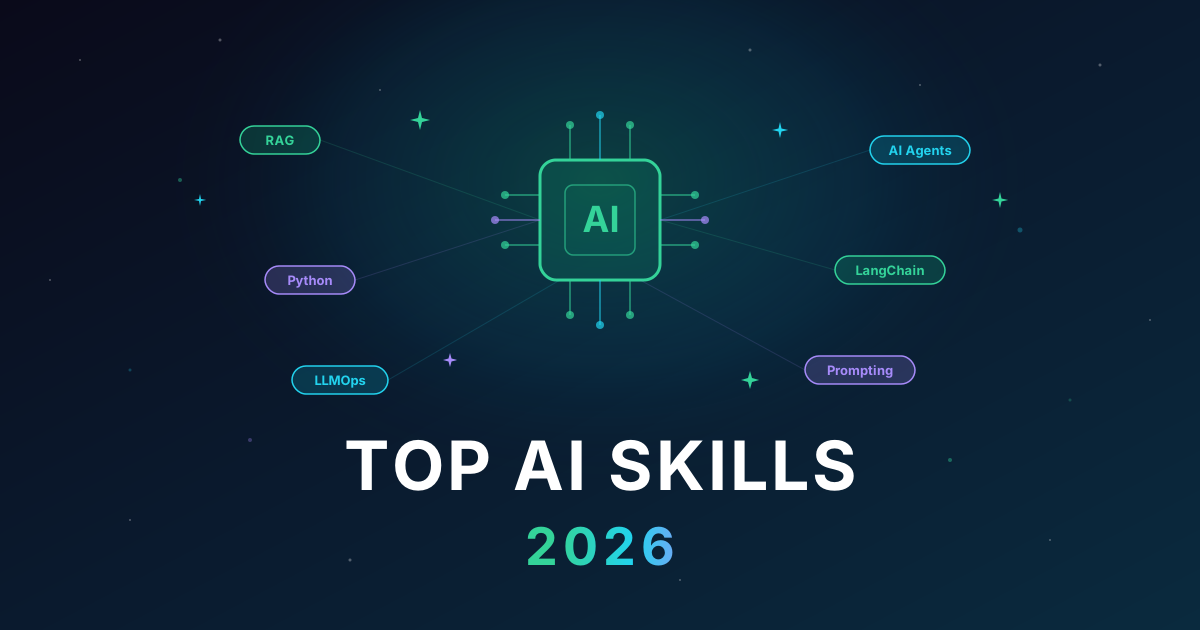
The 10 Most In-Demand AI Skills for 2026
Here are the skills employers are actively hiring for, ranked by demand and accessibility.
1. Prompt Engineering
Why it matters: Every AI application starts with a prompt. The ability to craft effective instructions that get consistent, high-quality results from LLMs is foundational to everything else on this list.
What to learn:
- System prompt design and optimization
- Few-shot and chain-of-thought prompting techniques
- Output formatting and structured data extraction
- Prompt testing and evaluation methodologies
- Multi-turn conversation design
Salary range: $90,000 - $147,000 base, with senior roles reaching $270,000+ total compensation (Glassdoor, Coursera). Prompt engineering drives a 35-43% salary uplift even in non-technical fields.
Accessibility: This is the most accessible AI skill -- demand surged 135.8% in 2025. You do not need to write code to get started, just an LLM and curiosity. However, the highest-paid prompt engineers combine prompting expertise with programming skills.
2. RAG (Retrieval-Augmented Generation)
Why it matters: RAG is the most common architecture pattern in enterprise AI applications. It solves the critical problem of making AI accurate and grounded in real data instead of hallucinating.
What to learn:
- Document ingestion and chunking strategies
- Text embeddings and vector similarity search
- Vector databases (Pinecone, ChromaDB, Weaviate, pgvector)
- Retrieval optimization and reranking
- Hybrid search (combining vector and keyword search)
Salary range: $140,000 - $200,000+. NLP engineers building RAG systems average $170,000 annually (Second Talent). RAG is described as "the most in-demand skill right now" across multiple industry surveys.
Why companies care: Every company has proprietary data -- customer records, internal docs, product catalogs -- that generic LLMs know nothing about. RAG is how they make AI useful with their own data. Learn more about what RAG is and how it works.
3. AI Agents and Tool Use
Why it matters: AI agents are the next evolution beyond chatbots. Instead of just answering questions, agents can take actions -- calling APIs, running code, searching the web, updating databases, and completing multi-step workflows autonomously.
What to learn:
- Tool-calling and function-calling with LLMs
- Agent orchestration frameworks (LangChain Agents, CrewAI, AutoGen)
- Planning and reasoning patterns (ReAct, chain-of-thought)
- Multi-agent systems and collaboration patterns
- Error handling and guardrails for autonomous AI
Salary range: $150,000 - $250,000+, with top agentic AI engineers exceeding $300,000. The average sits around $190,000.
Why it is hot: Gartner predicts 40% of enterprise applications will embed AI agents by the end of 2026, up from less than 5% in 2025. Inquiries about multi-agent systems surged 1,445% in just one year. Companies are moving from "AI answers questions" to "AI completes tasks" -- customer support agents that process refunds, research agents that compile reports, coding agents that write and test code. This is the fastest-growing segment of AI. Read our deep dive on how AI agents are transforming DevOps.
4. AI Frameworks (LangChain, CrewAI, and the New Ecosystem)
Why it matters: The AI framework landscape has matured rapidly. LangChain remains the most comprehensive ecosystem, but CrewAI (used by 40% of Fortune 500 companies), OpenAI's Agents SDK, and Google's Agent Development Kit are all gaining significant traction. Proficiency with at least one framework is a baseline requirement for AI engineering roles.
What to learn:
- Chains and pipelines for connecting LLMs to data (LangChain)
- Multi-agent orchestration with LangGraph or CrewAI
- MCP (Model Context Protocol) -- Anthropic's open standard for connecting AI agents to external tools, now adopted by OpenAI, Google, Microsoft, and AWS
- LlamaIndex for RAG-focused data pipelines
- Production deployment patterns and observability with LangSmith
Recommendation: Start with LangChain -- it has the largest ecosystem. Add CrewAI if you are building multi-agent systems. Learn MCP as the industry standard for tool integration -- it is the "USB-C port for AI agents."
5. Python for AI
Why it matters: Python is the undisputed language of AI. It appears in 47-58% of all AI/ML job listings, with over 1.25 million open positions globally requiring Python. It recently overtook JavaScript as the most popular language on GitHub. You cannot work in AI without it.
What to learn:
- Core Python (data structures, functions, classes, async/await)
- Working with APIs (requests, httpx, authentication)
- Data manipulation (pandas basics for data processing)
- Package management and virtual environments
- Jupyter notebooks for experimentation
Reality check: You do not need to be a Python expert. Intermediate proficiency is enough to build production AI applications. If you already know JavaScript, TypeScript, or another language, you can pick up enough Python in 2-4 weeks.
6. Vector Databases and Embeddings
Why it matters: Vector databases are the infrastructure layer of RAG and semantic search. Understanding how embeddings work and how to choose, configure, and optimize a vector database is essential for building AI applications that retrieve information accurately.
Key databases to know:
| Database | Best For | Type |
|---|---|---|
| Pinecone | Production RAG with minimal ops | Managed cloud |
| ChromaDB | Learning and prototyping | Open-source, local |
| Weaviate | Hybrid search (vector + keyword) | Open-source + cloud |
| pgvector | Teams already on PostgreSQL | PostgreSQL extension |
| Qdrant | High-performance, self-hosted | Open-source |
What to learn: How embeddings represent text as numbers, similarity metrics (cosine, dot product), chunking strategies, metadata filtering, and index optimization.
7. LLM API Integration
Why it matters: Building AI applications means working with LLM APIs from providers like OpenAI, Anthropic (Claude), Google (Gemini), and open-source models. Understanding how to call these APIs efficiently, handle errors, manage costs, and switch between providers is a practical, in-demand skill.
What to learn:
- Authentication and API key management
- Streaming responses for real-time UX
- Token counting and cost optimization
- Rate limiting and retry strategies
- Model selection (when to use GPT-4o vs Claude vs a smaller model)
8. AI Application Architecture
Why it matters: As AI moves from prototypes to production systems, companies need engineers who can design reliable, scalable AI architectures -- not just string together API calls.
What to learn:
- Designing RAG pipelines with fallback strategies
- Caching strategies for LLM responses
- Observability and logging for AI applications
- Cost management at scale (batching, model routing)
- Security considerations (prompt injection, data leakage)
Salary range: $180,000 - $300,000+ (senior/architect roles)
9. LLMOps and AI Deployment
Why it matters: Building an AI demo is one thing. Deploying it reliably to production with monitoring, evaluation, and continuous improvement is where most of the real-world complexity lives.
What to learn:
- Evaluation frameworks (testing AI output quality systematically)
- A/B testing for prompts and retrieval strategies
- Monitoring AI performance in production (latency, accuracy, cost)
- CI/CD for AI applications (prompt versioning, model updates)
- Tools: LangSmith, Weights & Biases, Helicone, Braintrust
10. Cloud Infrastructure for AI
Why it matters: AI applications need infrastructure -- compute for running models, storage for vector databases, networking for API integrations, and orchestration for complex pipelines. Cloud skills are the foundation that makes everything else work.
What to learn:
- AWS, Azure, or GCP fundamentals (networking, compute, storage)
- Container orchestration with Docker and Kubernetes
- Serverless deployment for AI endpoints
- GPU instance management for running open-source models
- Infrastructure as code (Terraform, CloudFormation) for reproducible AI environments
If you are looking to build cloud foundations alongside your AI skills, our guides on AWS 3-tier architecture with Terraform and Kubernetes with monitoring are good starting points.
You Do Not Need All 10 Skills
No one expects you to master everything on this list. Pick 3-4 skills that align with your career goals and focus there. A developer who knows Python + RAG + LangChain + one cloud platform is already highly employable. You can expand your skill set over time as you take on more complex projects.
Bonus: AI Ethics and Governance (Rising Fast)
Why it matters: With the EU AI Act tightening in 2026 and every major company establishing AI governance teams, demand for AI ethics skills has risen 125% and AI governance skills 150% year-over-year. This is no longer a soft skill -- it is becoming a distinct discipline with its own certifications (IAPP Certified AI Governance Professional) and career paths.
What to learn:
- Responsible AI frameworks and bias detection
- Data privacy in AI systems (GDPR, EU AI Act compliance)
- Prompt injection prevention and AI security
- Model evaluation for fairness and safety
- AI risk assessment and documentation
Who should consider this: If you come from a legal, compliance, or policy background, AI governance is one of the fastest on-ramps into the AI industry without deep technical skills.
What Is Trending in AI Right Now (Early 2026)
The AI landscape evolves fast. Here are the five biggest trends shaping the industry as of early 2026:
1. Agentic AI is going mainstream. Single-purpose chatbots are being replaced by orchestrated teams of specialized AI agents that can plan, execute, and verify their own work. Gartner predicts 40% of enterprise apps will embed agents by year-end. Every major AI lab has released its own agent framework.
2. MCP is the new industry standard. Anthropic's Model Context Protocol -- an open standard for connecting AI agents to external tools and data sources -- has been adopted by OpenAI, Google, Microsoft, and AWS. It was donated to the Linux Foundation in December 2025 and is quickly becoming the universal integration layer for AI applications.
3. Open-source AI is closing the gap. DeepSeek's models demonstrated that competitive AI can be built at a fraction of the cost of proprietary models, triggering a wave of open-source innovation. Models like Qwen, Llama, and Mistral now rival proprietary offerings on many benchmarks, giving developers more choice and lower costs.
4. Smaller, smarter models over bigger ones. The era of "just make it bigger" is ending. Innovation has shifted to post-training techniques -- reinforcement learning, fine-tuning, and efficient architectures that deliver better results from smaller, cheaper models. This makes AI more accessible for startups and individual developers.
5. Multimodal AI is the default. Processing text, images, audio, and video together is no longer a differentiator -- it is the expectation. When paired with agentic systems, multimodal models can see a screenshot, understand it, and take action. This opens up entirely new categories of AI applications.
AI Skill Roadmap: Where to Start Based on Your Background
If You Are a Software Developer
You have the biggest advantage. You already know how to code, work with APIs, and build applications. Your path:
- Week 1-2: Learn prompt engineering fundamentals and experiment with LLM APIs
- Week 3-4: Build a RAG application using LangChain and ChromaDB
- Week 5-6: Add agent capabilities -- tool use, web search, API integrations
- Week 7-8: Deploy a production-ready AI project and add it to your portfolio
If You Are a Career Changer
The data is encouraging: employers are increasingly adopting skills-first hiring, giving more weight to certifications, portfolio work, and assessments than to degrees. Professionals from customer service, writing, sales, teaching, and project management backgrounds are successfully transitioning into AI roles -- some requiring as little as 3-6 months of focused training. McKinsey projects AI will create 20-50 million new jobs by 2030, many of which do not exist yet.
Your path:
- Week 1-4: Learn Python basics (focus on practical skills, not theory)
- Week 5-6: Learn prompt engineering and how to work with LLM APIs
- Week 7-8: Build a simple RAG application to demonstrate your skills
- Week 9-12: Build 2-3 portfolio projects that solve real problems
- Ongoing: Learn cloud fundamentals and expand into agent development
Accessible Entry Roles for Career Changers
You do not have to aim for "AI Engineer" on day one. Roles like AI Prompt Engineer, AI Product Manager, AI Ethics Specialist, and AI Trainer/Annotator are realistic entry points that value domain expertise from other fields. From there, you can build technical depth over time.
If You Are a DevOps or Cloud Engineer
You already have cloud infrastructure skills -- one of the hardest pieces for AI engineers to learn. Your advantage:
- Week 1-2: Learn prompt engineering and the AI application stack
- Week 3-4: Build a RAG pipeline and understand vector databases
- Week 5-6: Focus on LLMOps -- deployment, monitoring, and scaling AI applications
- Week 7-8: Build an AI-powered DevOps tool (incident responder, log analyzer, infrastructure assistant)
How to Actually Learn These Skills (Not Just Read About Them)
Here is the hard truth about AI skills: reading tutorials and watching videos is not enough. The engineers getting hired are the ones who have built things.
The most effective way to learn AI is through hands-on practice:
- Build real projects -- Not toy demos, but applications that solve actual problems
- Work through structured labs -- Step-by-step exercises that teach concepts through doing
- Debug real errors -- The troubleshooting skills you develop while building are as valuable as the technical knowledge
- Ship to production -- Even a small project deployed publicly teaches more than a dozen tutorials
If you want a structured place to start, our AI & Machine Learning courses turn the skills on this list -- RAG pipelines, LLM fine-tuning, MLOps, agents -- into hands-on labs with working code.
Learn AI by Building, Not Just Reading
CloudaQube generates personalized AI lab training based on exactly what you want to learn. Describe a topic like "Build a RAG chatbot with LangChain and Pinecone" and get a complete hands-on lab with step-by-step instructions, code examples, curated video tutorials, and hints -- generated by AI in seconds. It is the fastest way to go from "I want to learn AI" to actually building AI applications.
Want to practice this hands-on?
CloudaQube generates complete labs from a simple description. Try it free.
Get Started FreeCompanies Hiring for AI Skills Right Now
The scale of AI investment is staggering: Goldman Sachs estimates AI hyperscalers will spend $527 billion on AI infrastructure in 2026 alone. Gartner projects total worldwide AI spending will reach $2 trillion this year. That money translates directly into jobs.
AI hiring is not limited to Silicon Valley startups. Here are the types of companies actively building AI teams in 2026:
- Big Tech -- Google, Microsoft, Amazon, Meta, and Apple all have massive AI initiatives and are hiring across all experience levels
- AI-native startups -- Companies like Anthropic, OpenAI, Cohere, Mistral, and hundreds of well-funded startups building AI products and infrastructure
- Enterprise software -- Salesforce, ServiceNow, Datadog, and other SaaS companies are embedding AI into their platforms
- Financial services -- Banks, hedge funds, and fintech companies using AI for fraud detection, risk analysis, and customer service
- Healthcare -- AI-powered diagnostics, drug discovery, and clinical decision support systems
- Consulting -- McKinsey, Deloitte, Accenture, and others hiring AI specialists to serve enterprise clients
- Every company with a tech team -- Increasingly, AI skills are not a separate job -- they are expected from software engineers, data engineers, and DevOps professionals
The key takeaway: AI skills are becoming a general requirement, not just a specialty. The sooner you start building them, the better positioned you will be.
Common Mistakes to Avoid
As you learn AI skills, watch out for these common traps:
Trying to learn everything at once. The AI ecosystem is enormous. Pick a focused path and go deep before going broad. Mastering RAG with one framework is more valuable than superficially knowing five frameworks.
Skipping the fundamentals. Prompt engineering and Python are not glamorous, but they are the foundation of everything else. Engineers who skip these basics hit a wall when they try to build more complex applications.
Only reading, never building. The gap between understanding a concept and implementing it is huge. Budget at least 70% of your learning time for hands-on building.
Ignoring cloud and infrastructure. You can build an AI demo on your laptop, but production AI applications run in the cloud. Cloud skills are the bridge between "I built a prototype" and "I can ship this to users."
Waiting for the "right" time. AI tools and frameworks are evolving fast, and there will never be a "stable" moment to start. The fundamentals (Python, APIs, prompting, RAG architecture) are stable enough. Start now and evolve with the ecosystem.
Frequently Asked Questions
What is the single best AI skill to learn first in 2026?
Prompt engineering. It is the most accessible entry point, it is useful regardless of your role, and it teaches you how LLMs think -- which is foundational for everything else. Combine it with Python basics and you are ready to build real AI applications.
Do I need a computer science degree to get an AI job?
No. The AI engineering field is pragmatic. Employers care about what you can build, not your credentials. A strong portfolio of projects demonstrating RAG, agent development, or AI application architecture will open more doors than a degree. That said, understanding programming fundamentals is essential.
How long does it take to become job-ready in AI?
For experienced developers: 4-8 weeks of focused learning and building. For career changers: 3-6 months with consistent effort (10-15 hours per week). The key variable is not time spent reading -- it is time spent building projects and solving real problems.
Is AI replacing software engineers?
AI is augmenting software engineering, not replacing it. AI coding assistants make developers more productive, but someone still needs to design systems, make architectural decisions, review code, and ensure quality. The engineers who learn to work with AI tools will be more valuable, not less.
Which AI framework should I learn -- LangChain or LlamaIndex?
Start with LangChain. It has the larger community, more tutorials, and broader capabilities (both RAG and agents). LlamaIndex is excellent for RAG-specific work, so consider adding it later if your focus is data retrieval. Neither is a bad choice.
Are AI skills relevant if I do not want to be an "AI engineer"?
Absolutely. AI skills are increasingly expected in traditional software engineering, DevOps, data engineering, and product management roles. Even if your title does not include "AI," understanding how to integrate LLMs, build RAG pipelines, and use AI tools will make you more effective and more employable.
What is the difference between AI engineering and machine learning engineering?
AI engineering focuses on building applications using pre-trained models (LLMs, embedding models) through APIs and frameworks. Machine learning engineering focuses on training custom models from data. AI engineering is more accessible, more in-demand in 2026, and requires less mathematical background. Many roles overlap, but the skill sets are distinct.
How do I build an AI portfolio that stands out?
Build 2-3 projects that solve real problems, not just tutorials. Examples: a RAG-powered Q&A system for a specific domain (legal docs, medical guidelines, product docs), an AI agent that automates a workflow (research, customer support, code review), or an application that combines RAG with a useful UI. Deploy them publicly and write about what you learned.
Will AI skills still be relevant in 5 years?
The specific tools will evolve -- LangChain today might be something else in 2028. But the core skills -- working with LLMs, designing retrieval systems, building agent workflows, deploying AI to production -- are only becoming more fundamental. Companies have invested trillions in AI infrastructure and are reporting 3.7x ROI on generative AI spending (McKinsey). This is not a hype cycle that fades -- it is a permanent shift in how software is built.
What AI certifications are worth getting?
The most valued certifications in 2026 include AWS Certified Machine Learning - Specialty (associated with a ~20% salary boost), the new AWS Certified Generative AI Developer – Professional (AIP-C01), Google Cloud Professional ML Engineer, and the IAPP Certified AI Governance Professional (AIGP). That said, multiple hiring managers emphasize that a strong portfolio of deployed projects matters more than certifications alone. Ideally, pursue both.