The demand for AI skills is unlike anything the tech industry has seen before. Since the release of ChatGPT in late 2022, job postings mentioning generative AI, large language models, and AI engineering have surged by over 300%. Companies across every industry -- from finance to healthcare to e-commerce -- are racing to build AI-powered products, and they need people who know how.
Two terms keep appearing at the top of those job postings: RAG and AI agents. If you understand what they are and how to build with them, you are positioning yourself for some of the most exciting and well-compensated roles in technology.
This guide explains both concepts in plain language, covers the tools and skills you need, and maps out the career paths opening up in this space.
The AI Skills Boom: By the Numbers
Before diving into the technology, here is a snapshot of the market:
- AI engineer is now one of the fastest-growing job titles in tech, with a 65% increase in postings year-over-year
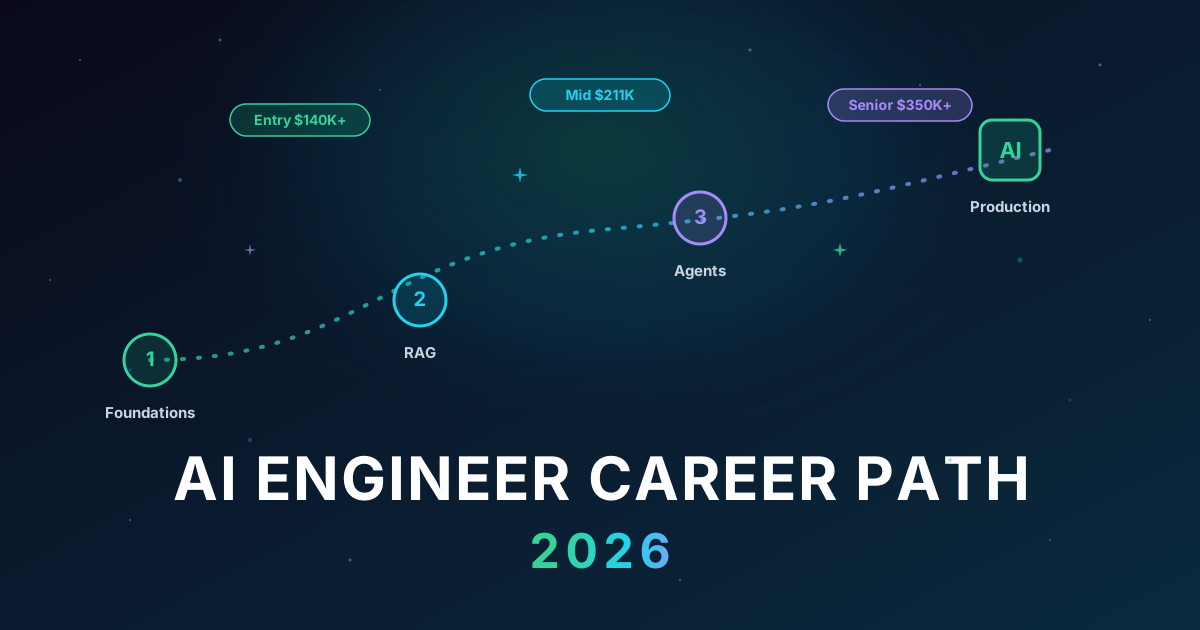
- The average salary for AI engineers in the United States ranges from $140,000 to $250,000+, depending on experience
- Companies report that AI skills command a 25-40% salary premium over equivalent non-AI roles
- Over 80% of Fortune 500 companies have active generative AI initiatives, according to McKinsey's 2025 State of AI report
- The global AI market is projected to reach $300 billion by 2027
The takeaway: AI skills are not just a nice-to-have. They are becoming a core requirement for a growing number of engineering and product roles.
What Is RAG? (Retrieval-Augmented Generation)
RAG stands for Retrieval-Augmented Generation, and it solves one of the biggest limitations of large language models.
Here is the problem: LLMs like GPT-4 and Claude are trained on massive datasets, but they can only answer questions based on what they learned during training. Ask an LLM about your company's internal documentation, last week's sales report, or a proprietary knowledge base, and it will either make something up (hallucinate) or admit it does not know.
RAG fixes this by giving the AI a reference library it can search in real time.
How RAG Works (The Simple Version)
- You upload your documents -- company knowledge bases, product docs, legal contracts, research papers, whatever your data source is
- The system converts those documents into searchable formats using a technique called embedding (turning text into mathematical representations)
- When a user asks a question, the system searches those documents for the most relevant passages
- The relevant passages are handed to the LLM along with the question
- The LLM generates an answer grounded in your actual data, not just its training data
Think of it this way: without RAG, an AI is like a brilliant student taking an exam from memory. With RAG, that same student gets to bring their notes and textbooks to the test. The answers are more accurate, more specific, and grounded in real information.
Why Not Just Fine-Tune?
Fine-tuning means retraining an AI model on your specific data. It works, but it is expensive, time-consuming, and the model can still hallucinate. RAG is faster to implement, cheaper to run, and keeps the AI's answers grounded in retrievable source documents. For most business applications, RAG is the more practical approach.
What Are AI Agents?
If RAG is about giving AI access to information, AI agents are about giving AI the ability to take action.
An AI agent is an autonomous system that can:
- Understand a goal -- Interpret what the user wants to accomplish
- Plan steps -- Break the goal down into a sequence of actions
- Use tools -- Call APIs, search databases, run code, browse the web, or interact with other software
- Evaluate results -- Check whether the action succeeded and adjust the plan if needed
- Complete the task -- Deliver a finished result, not just a text response
Real-World Examples
- Customer support agent -- A user asks "Can you cancel my subscription and issue a refund?" The agent checks the account status, processes the cancellation through the billing API, initiates the refund, and confirms the result -- all without human intervention.
- Research agent -- An analyst asks "Find the top 5 competitors in our space, compare their pricing, and summarize the results in a table." The agent searches the web, visits competitor websites, extracts pricing data, and compiles a comparison.
- Code assistant agent -- A developer describes a feature. The agent writes the code, runs tests, fixes failing tests, and opens a pull request.
The key difference from a regular chatbot: agents do not just respond, they act. They combine the reasoning power of LLMs with the ability to interact with real-world systems. AI agents are already transforming fields like DevOps, where they automate infrastructure management, incident response, and deployment workflows.
RAG + Agents = Power Combination
The most powerful AI applications combine both concepts. An agent might use RAG to search your company's knowledge base, then take action based on what it finds -- like updating a support ticket, generating a report, or escalating an issue. Understanding both gives you the ability to build complete AI-powered workflows.
Why RAG and AI Agents Matter for Businesses
Companies are investing heavily in these technologies because they solve real business problems:
- Accuracy -- RAG dramatically reduces hallucinations by grounding AI responses in verified source documents
- Custom knowledge -- Businesses can build AI that knows their products, policies, and processes without expensive model training
- Automation -- AI agents can handle repetitive tasks that previously required human intervention, from customer support to data entry to report generation
- Scalability -- A single AI agent can handle thousands of interactions simultaneously
- Speed -- Tasks that took hours (research, document review, data analysis) can be completed in seconds
This is why AI engineering roles are commanding premium salaries. The business impact is direct and measurable.
Key Tools and Frameworks to Know
If you want to build RAG systems and AI agents, you will work with a specific ecosystem of tools. Here is the landscape:
Orchestration Frameworks
| Framework | What It Does | Best For | Learning Curve |
|---|---|---|---|
| LangChain | Connects LLMs to data sources and tools | General-purpose AI applications | Moderate |
| LlamaIndex | Specializes in data ingestion and retrieval | RAG-focused applications | Moderate |
| CrewAI | Multi-agent orchestration framework | Complex agent workflows | Moderate-High |
| AutoGen | Microsoft's multi-agent conversation framework | Research and enterprise agents | Moderate-High |
Vector Databases (for RAG)
| Database | Type | Best For | Free Tier |
|---|---|---|---|
| Pinecone | Managed cloud service | Production RAG, minimal ops overhead | Yes (limited) |
| ChromaDB | Open-source, local-first | Prototyping, development, small-scale RAG | Free (open-source) |
| Weaviate | Open-source with cloud option | Hybrid search (vector + keyword) | Yes |
| pgvector | PostgreSQL extension | Teams already using PostgreSQL | Free (open-source) |
LLM Providers
| Provider | Key Models | Strengths |
|---|---|---|
| OpenAI | GPT-4o, GPT-4o mini | Widest ecosystem, strong general performance |
| Anthropic | Claude 4, Claude Sonnet | Extended context windows, safety focus |
| Gemini 2.0 | Multimodal, deep Google Cloud integration | |
| Open-source | Llama 3, Mistral, Qwen | Privacy, customization, no API costs |
You Do Not Need to Master All of Them
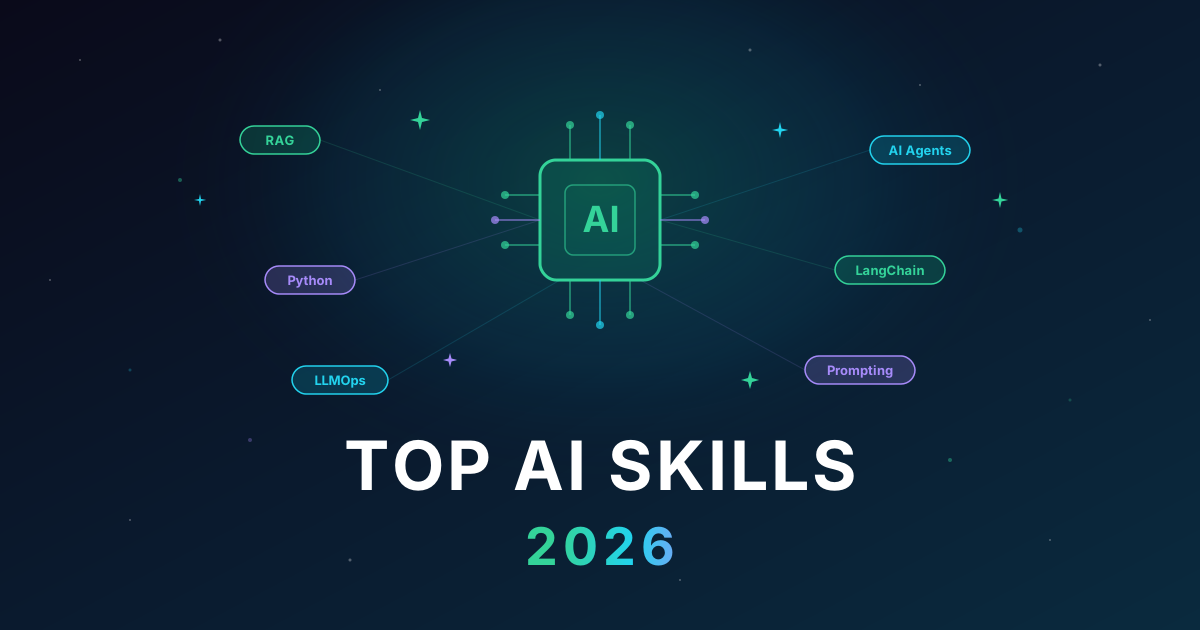
Pick one orchestration framework (LangChain is the most popular starting point), one vector database (ChromaDB for learning, Pinecone for production), and one LLM provider. You can expand your toolkit later as you take on more complex projects.
AI Engineering Career Paths and Salaries
AI engineering is a new and rapidly evolving field, but clear career paths are emerging. Certifications can help validate your expertise -- see our guide to the AWS Generative AI Developer certification for one of the most relevant credentials in this space.
Prompt Engineer
- Salary range: $80,000 - $130,000
- What you do: Design and optimize prompts for LLMs, build prompt templates, evaluate output quality
- Skills needed: Strong writing, understanding of LLM behavior, basic Python
- Good entry point for: People from non-engineering backgrounds
AI/ML Engineer
- Salary range: $140,000 - $220,000
- What you do: Build RAG pipelines, develop AI agents, integrate LLMs into products, optimize performance and cost
- Skills needed: Python, APIs, vector databases, LLM frameworks, system design
- Good entry point for: Software engineers and data scientists
Senior AI Architect
- Salary range: $200,000 - $300,000+
- What you do: Design end-to-end AI systems, evaluate build-vs-buy decisions, lead AI strategy, mentor teams
- Skills needed: Deep expertise in ML systems, distributed computing, production AI, leadership
- Good entry point for: Experienced engineers moving into AI leadership
Machine Learning Engineer (Traditional)
- Salary range: $130,000 - $200,000
- What you do: Train and deploy custom models, build ML pipelines, work with structured data and classical ML
- Skills needed: Mathematics, statistics, PyTorch/TensorFlow, MLOps
- Note: This is a more traditional role that overlaps with but is distinct from AI engineering
Skills You Need to Build AI Applications
Here is a practical breakdown of what you need to learn, organized by priority:
Must-have skills:
- Python -- The dominant language for AI development. You do not need to be an expert, but you need to be comfortable writing and reading Python code
- APIs and integrations -- Understanding how to call APIs, handle authentication, and process JSON responses
- Prompt engineering -- Crafting effective instructions for LLMs, including system prompts, few-shot examples, and output formatting
- Vector databases -- Understanding embeddings, similarity search, and how to ingest and query documents
Important skills to develop:
- LLM frameworks -- Proficiency with LangChain, LlamaIndex, or similar tools
- System design -- Designing reliable, scalable AI applications (caching, error handling, cost management)
- Evaluation and testing -- Measuring AI output quality, building test suites, and catching regressions
Nice-to-have skills:
- Fine-tuning -- Customizing models for specific domains
- MLOps -- Deploying and monitoring AI models in production
- Frontend development -- Building user interfaces for AI-powered applications
How Companies Are Using RAG Today
RAG is not theoretical. Companies across industries are deploying it right now:
- Customer support -- Companies like Klarna and Intercom use RAG-powered chatbots that answer questions based on help docs, product guides, and account data, resolving up to 60% of inquiries without a human agent
- Legal research -- Law firms use RAG to search through thousands of contracts, case files, and regulations, reducing research time from hours to minutes
- Healthcare -- Medical systems use RAG to help clinicians search clinical guidelines, drug databases, and patient records for evidence-based decisions
- Internal knowledge management -- Enterprises build RAG-powered assistants that search across Confluence, Notion, Slack, and internal wikis, making institutional knowledge accessible to every employee
- Financial analysis -- Investment firms use RAG to analyze earnings reports, SEC filings, and market research, generating summaries and extracting insights in seconds
- Education -- Learning platforms use RAG to create AI tutors that answer student questions using course materials, textbooks, and supplementary resources
Each of these use cases follows the same pattern: take a large body of specialized documents, make them searchable, and let an LLM generate answers grounded in that data.
How to Get Started Learning AI Skills
The AI field moves fast, but the fundamentals are stable. Here is a practical roadmap:
Phase 1: Foundations (2-4 weeks)
- Learn Python basics if you do not already know them
- Understand what LLMs are and how they work at a conceptual level
- Experiment with prompt engineering using ChatGPT, Claude, or any LLM
- Learn what APIs are and how to call them in Python
Phase 2: Build Your First RAG Application (2-4 weeks)
- Learn about embeddings and vector databases
- Set up a simple RAG pipeline using LangChain and ChromaDB
- Ingest a set of documents and build a question-answering system
- Experiment with different chunking strategies and prompts
Phase 3: Build an AI Agent (2-4 weeks)
- Learn how tool-calling works with LLMs
- Build a simple agent that can search the web, run calculations, or interact with an API
- Explore frameworks like LangChain Agents or CrewAI
- Combine RAG with agent capabilities
Phase 4: Go Deeper (Ongoing)
- Study evaluation techniques for measuring AI quality
- Learn about cost optimization and production deployment
- Explore advanced topics like multi-agent systems and fine-tuning
- Build portfolio projects that demonstrate your skills
Build Projects, Not Just Tutorials
The fastest way to learn AI engineering is to build real projects. Pick a problem you care about -- a personal knowledge base, a document analyzer, a research assistant -- and build a working solution. The debugging, troubleshooting, and design decisions you encounter along the way teach more than any tutorial.
Want to practice this hands-on?
CloudaQube generates complete labs from a simple description. Try it free.
Get Started FreeFrequently Asked Questions
Do I need a machine learning background to work with RAG and AI agents?
No. Traditional machine learning involves training models from scratch, which requires deep math and statistics knowledge. Building RAG systems and AI agents is closer to software engineering -- you are connecting pre-built components (LLMs, vector databases, APIs) rather than training models. A solid programming foundation and willingness to learn are enough to get started.
Is AI engineering just a hype cycle that will fade?
The underlying technology is real and already delivering measurable business value. While specific tools and frameworks will evolve (LangChain today, something else tomorrow), the core skills -- working with LLMs, building retrieval systems, designing agent workflows -- will remain relevant. The companies investing billions in AI infrastructure are not making short-term bets.
What programming language should I learn for AI engineering?
Python, without question. It is the dominant language for AI and machine learning, with the richest ecosystem of libraries and frameworks. JavaScript/TypeScript is a secondary option if you are building AI-powered web applications, but Python should be your primary language.
How is AI engineering different from data science?
Data science focuses on analyzing data, finding patterns, and building statistical models. AI engineering focuses on building applications that use pre-trained AI models to solve user-facing problems. There is overlap, but AI engineering is more about software development, system design, and product building than statistical analysis.
Can I learn AI engineering without a computer science degree?
Yes. Many successful AI engineers come from bootcamps, self-study, and adjacent fields like web development or data analysis. What matters is your ability to build working applications, not your credentials. Focus on building a portfolio of projects that demonstrate your skills.
What is the difference between RAG and fine-tuning?
RAG retrieves relevant information at query time and provides it to the LLM as context. Fine-tuning retrains the model itself on your specific data. RAG is faster to implement, easier to update, and keeps answers traceable to source documents. Fine-tuning is better for changing the model's style, behavior, or teaching it specialized knowledge that does not fit well into a retrieval pattern. Most applications start with RAG.