If you have ever used an online banking app, ordered food through a delivery service, or streamed a movie, you have interacted with a 3-tier architecture. It is one of the most widely used design patterns in software engineering, and understanding it is a foundational skill for anyone pursuing a career in cloud computing or software development.
In this guide, we will break down what 3-tier architecture is, why companies rely on it, and how you can start building one yourself -- no prior architecture experience required.
What Is a 3-Tier Architecture?
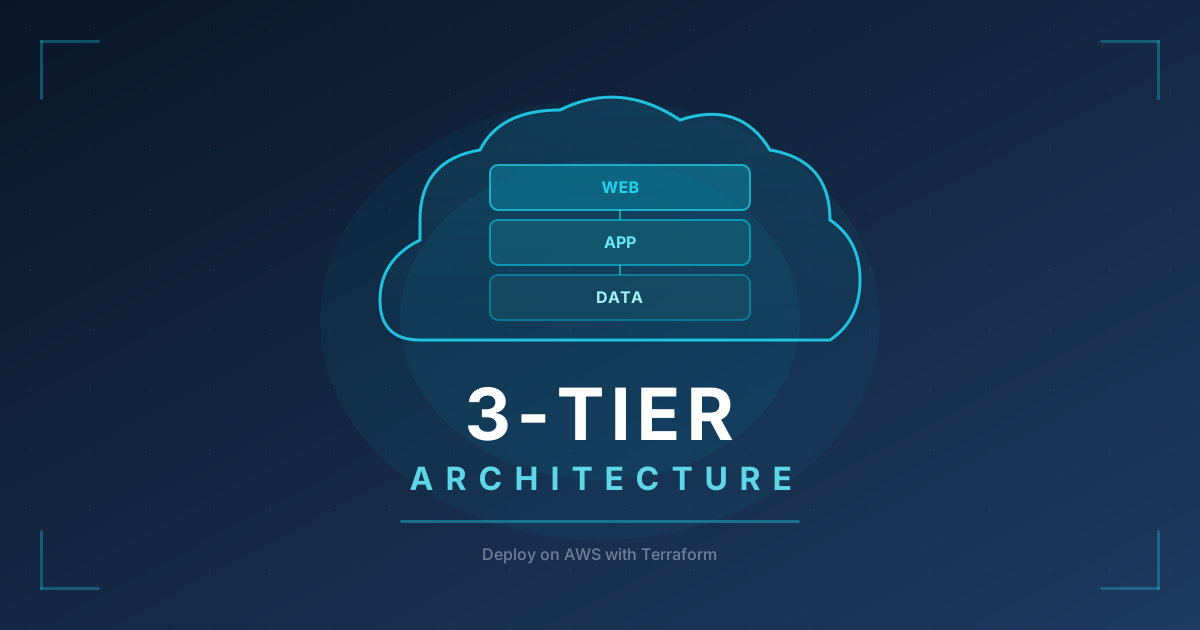
A 3-tier architecture is a way of organizing an application into three separate layers, each with a specific job:
- Presentation tier (the frontend): This is what users see and interact with. It could be a website, a mobile app, or a desktop application. Its only job is to display information and collect user input.
- Logic tier (the backend): This is the brain of the application. It processes requests, applies business rules, and makes decisions. When you click "Place Order," the logic tier validates your payment, checks inventory, and creates the order.
- Data tier (the database): This is where information lives. Customer accounts, product catalogs, order histories -- all stored and retrieved by the data tier.
Think of it like a restaurant. The presentation tier is the dining room where customers place orders. The logic tier is the kitchen where chefs prepare the food. The data tier is the pantry and refrigerator where ingredients are stored.
Why Three Tiers?
The key idea is separation of concerns. Each layer does one thing well and communicates only with the layer next to it. The frontend never talks directly to the database. This makes the system easier to build, secure, and scale.
Why Do Companies Use 3-Tier Architecture?
Nearly every major tech company uses some form of tiered architecture. Here is why it remains the go-to pattern after decades of use:
Scalability. Each tier can scale independently. Getting a surge of visitors? Add more frontend servers without touching the database. Running complex calculations? Scale up the logic tier. This flexibility is critical for handling unpredictable traffic.
Security. By separating layers, you create natural security boundaries. The database sits behind the logic tier with no direct exposure to the internet. Even if an attacker compromises a frontend server, they cannot reach your data directly.
Maintainability. Teams can work on different tiers independently. Your frontend developers can redesign the user interface without affecting the backend. Your database team can optimize queries without breaking the application. This speeds up development significantly.
Reliability. If one tier has an issue, it does not necessarily bring down the entire application. You can also add redundancy at each tier -- multiple web servers, multiple application servers, database replicas -- so that a single failure does not cause an outage.
Real-World Examples
Some of the world's largest applications use tiered architectures as their foundation:
-
Netflix separates its user-facing web and mobile apps (presentation) from its recommendation engine and streaming logic (logic tier), which in turn connects to massive content databases and user profile stores (data tier). This separation lets Netflix scale its streaming infrastructure independently from its recommendation system.
-
Uber uses a tiered approach where the rider and driver apps communicate with backend services that handle ride matching, pricing, and routing, all backed by databases storing trip data, user profiles, and map information.
-
E-commerce platforms like Amazon and Shopify follow the same pattern: a storefront that users browse, business logic that handles cart management, payment processing, and inventory checks, and databases storing millions of products and orders.
These companies have evolved beyond a simple 3-tier model into microservices, but the fundamental principle of separating presentation, logic, and data remains at the core of their architecture.
3-Tier vs Monolith vs Microservices
When researching architecture patterns, you will encounter three common approaches. Here is how they compare:
| Feature | Monolith | 3-Tier Architecture | Microservices |
|---|---|---|---|
| Structure | Everything in one codebase | Three separate layers | Many small, independent services |
| Complexity | Low (simple to start) | Moderate (clear boundaries) | High (many moving parts) |
| Scalability | Limited (scale everything together) | Good (scale each tier independently) | Excellent (scale individual services) |
| Team Size | Small teams (1-10 developers) | Medium teams (5-50 developers) | Large teams (20+ developers) |
| Deployment | One deployment unit | Deploy tiers separately | Deploy services independently |
| Best For | MVPs, prototypes, small apps | Most web applications and APIs | Large-scale, complex platforms |
| Examples | Early-stage startups | Most enterprise web apps | Netflix, Uber, Amazon |
For most teams and projects, 3-tier architecture hits the sweet spot. It provides real separation and scalability benefits without the operational complexity of managing dozens of microservices.
Start Simple, Evolve Later
Many successful companies started with a 3-tier architecture and gradually migrated to microservices as their team and traffic grew. You do not need to start with the most complex architecture on day one.
How to Build a 3-Tier Architecture in the Cloud
Building a 3-tier architecture on a cloud platform like AWS, Azure, or GCP follows a similar pattern regardless of the provider. Here is a high-level overview of what each tier looks like in the cloud:
Presentation Tier
- A load balancer (like AWS ALB, Azure Application Gateway, or GCP Cloud Load Balancing) distributes incoming traffic across multiple servers
- Static assets (HTML, CSS, JavaScript) can be served from a CDN like CloudFront or Cloud CDN for faster delivery worldwide
Logic Tier
- Compute resources run your application code -- this could be virtual machines (EC2, Azure VMs), containers (ECS, AKS, GKE), or serverless functions (Lambda, Azure Functions)
- An auto-scaling group automatically adds or removes servers based on traffic demand
- These servers sit in private subnets with no direct internet access for added security
Data Tier
- A managed database service (RDS, Azure SQL, Cloud SQL) stores your application data
- Multi-region or multi-availability-zone deployment provides automatic failover if one data center goes down
- The database lives in isolated subnets that only the logic tier can reach
Infrastructure as Code
Instead of manually clicking through a cloud console to create these resources, professional teams use Infrastructure as Code (IaC) tools to define everything in configuration files:
- Terraform is the most popular multi-cloud IaC tool, using its own language called HCL
- AWS CloudFormation is AWS's native IaC service using YAML or JSON templates
- Pulumi lets you define infrastructure using familiar programming languages like Python or TypeScript
Each tool has distinct strengths depending on your cloud strategy and team background -- see our detailed comparison of Terraform, CloudFormation, and Pulumi to decide which fits your workflow. These tools let you version-control your infrastructure, reproduce environments consistently, and tear down everything cleanly when you are done.
What Skills Do You Need?
To design and build 3-tier architectures, you will want to develop skills across several areas:
- Cloud networking: Understanding VPCs, subnets, security groups, and load balancers is essential. This is the foundation everything else sits on.
- Compute services: Know how to work with virtual machines, containers, or serverless functions depending on your use case.
- Database management: Understand the differences between relational databases (PostgreSQL, MySQL) and NoSQL options (DynamoDB, MongoDB), and when to use each.
- Infrastructure as Code: Learn at least one IaC tool. Terraform is the most in-demand skill on job listings.
- Security fundamentals: Understand network segmentation, IAM roles and policies, encryption at rest and in transit, and the principle of least privilege. Our guide to cloud security and server hardening covers the essential skills you will need.
You do not need to master all of these at once. Start with one cloud platform (AWS is the most popular for job seekers), learn the networking basics, and build your way up.
Career Relevance: Cloud Architect Roles
Understanding 3-tier architecture is a stepping stone to some of the most in-demand and well-compensated roles in tech:
Cloud Architect -- Designs and oversees cloud infrastructure for organizations. Average salary in the United States ranges from $140,000 to $190,000 per year, according to Glassdoor and LinkedIn data.
Solutions Architect -- Works with customers or internal teams to design cloud-based solutions. AWS Solutions Architect is one of the most sought-after certifications in the industry. Average salary: $130,000 to $170,000.
DevOps Engineer -- Builds and maintains the infrastructure and deployment pipelines that support applications. Average salary: $120,000 to $160,000.
Site Reliability Engineer (SRE) -- Focuses on the reliability and performance of production systems. Average salary: $140,000 to $185,000.
All of these roles expect a solid understanding of tiered architecture patterns, cloud networking, and infrastructure as code.
Certifications That Help
The AWS Solutions Architect Associate, Azure Solutions Architect Expert, and Google Cloud Professional Cloud Architect certifications all test your understanding of multi-tier architectures. Earning one of these can significantly boost your resume and starting salary.
How to Practice: Hands-On Labs
Reading about architecture is useful, but building one yourself is where real learning happens. As we discuss in our guide to hands-on cloud labs, the best way to internalize these concepts is to get hands-on:
- Start with a simple deployment. Build a basic 3-tier app with a load balancer, a web server, and a database on any cloud platform.
- Break things on purpose. Shut down a server and watch the load balancer route around it. Fill up a database and see what happens. This builds the intuition that documentation cannot provide.
- Automate with IaC. Rebuild the same architecture using Terraform or CloudFormation instead of the console. This is the skill employers are actually testing for.
- Add production features. Enable auto-scaling, set up monitoring, configure backups, and add HTTPS. Each addition teaches you something new.
With CloudaQube, you can skip the setup headaches and jump straight into building. Describe what you want to learn -- like "build a 3-tier architecture on AWS with Terraform" -- and CloudaQube's AI generates a complete hands-on lab tailored to your skill level. It is the fastest way to go from reading about architecture to actually deploying one.
Frequently Asked Questions
Is 3-tier architecture outdated?
Not at all. While microservices get more attention in blog posts and conference talks, the vast majority of production applications still use a tiered architecture. It provides an excellent balance of simplicity, scalability, and maintainability. Even companies running microservices organize individual services using tiered patterns internally.
How much does it cost to run a 3-tier architecture in the cloud?
Costs vary widely depending on the cloud provider, region, and scale. A minimal development setup on AWS (one small load balancer, two small EC2 instances, and a small RDS database) might cost $80 to $150 per month. Production setups with auto-scaling, multi-AZ databases, and proper networking can range from $500 to several thousand per month -- our guide on AWS cost optimization and autoscaling covers strategies to keep these costs under control. Most cloud providers offer free tiers that let you experiment at no cost.
Do I need to learn all three cloud providers?
No. Start with one. AWS has the largest market share and the most job openings, so it is a solid default choice. The architectural concepts (load balancers, auto-scaling, managed databases) transfer directly between providers. Once you understand one, picking up a second is much faster.
What is the difference between 3-tier architecture and MVC?
MVC (Model-View-Controller) is a software design pattern used within application code. 3-tier architecture is an infrastructure pattern that describes how an entire system is deployed and organized. You can use MVC within the logic tier of a 3-tier architecture -- they operate at different levels of abstraction.
Want to practice this hands-on?
CloudaQube generates complete labs from a simple description. Try it free.
Get Started Free