Introduction: The Cloud Skills Gap Is Real
The demand for cloud professionals continues to outstrip supply. A 2025 Global Knowledge IT Skills and Salary Report found that 74% of IT decision-makers face a significant cloud skills gap within their organizations, and the shortage is widening. Cloud spending exceeded $800 billion globally in 2025, yet employers consistently report that they cannot find enough qualified engineers to architect, deploy, and maintain the infrastructure that spending represents.
The irony is that there has never been more educational content available. Thousands of video courses, blog posts, certification prep materials, and documentation pages cover every cloud service imaginable. People are consuming this content in record numbers. Yet the skills gap persists.
The problem is not a lack of information. It is a lack of practice.
The Problem with Passive Learning
Most cloud education follows a passive model: watch a video, read documentation, take notes, memorize for an exam. This approach feels productive. You finish a 40-hour course and believe you have learned the material. But when you sit down to build something real, to deploy a Kubernetes cluster, configure a VPC, or troubleshoot a failing Lambda function, you discover that knowledge and skill are not the same thing.
Why Passive Learning Fails for Technical Skills
Recognition is not recall. Watching an instructor configure an S3 bucket policy feels familiar when you see it again. But familiarity is not competence. When you need to write that policy yourself, from a blank screen with a real deadline, the gap between recognizing a correct configuration and producing one becomes painfully clear.
Context switching destroys retention. A typical video course moves through dozens of services and concepts in rapid succession. By the time you reach module 12, you have forgotten the details of module 3. Without the reinforcement that comes from applying knowledge, it fades quickly.
Passive consumption does not build mental models. Technical expertise requires you to understand how systems interact: how a security group relates to a subnet, how an IAM role connects to a Lambda function, how a pod scheduler considers resource requests. These relationships only become intuitive through hands-on experience where you see the consequences of your decisions.
The Forgetting Curve
Research by Hermann Ebbinghaus demonstrated that without reinforcement, people forget approximately 70% of new information within 24 hours and up to 90% within a week. Active practice is the most effective form of reinforcement because it forces retrieval, which strengthens memory encoding.
The Science Behind Experiential Learning
The case for hands-on learning is not just anecdotal. Decades of educational research support the idea that doing is the most effective form of learning, particularly for complex technical skills.
Kolb's Experiential Learning Cycle
David Kolb's experiential learning model, first published in 1984 and still widely cited in educational research, describes learning as a four-stage cycle:
- Concrete Experience: You perform an activity (deploy a resource, configure a service, fix a broken cluster)
- Reflective Observation: You observe the outcome (did it work? What happened? What errors appeared?)
- Abstract Conceptualization: You form a theory (this failed because the security group blocked port 443; next time I need to add an inbound rule)
- Active Experimentation: You test your theory by trying again with the new understanding
Each pass through this cycle deepens understanding. Passive learning only engages stages 2 and 3, and even then only partially, because you are reflecting on someone else's experience rather than your own.
The Learning Pyramid
Research on information retention rates, often attributed to the National Training Laboratories (though the exact numbers are debated among researchers), suggests the following approximate retention rates by learning method:
| Learning Method | Approximate Retention |
|---|---|
| Lecture / reading | 5-10% |
| Audio / visual (videos) | 20% |
| Demonstration | 30% |
| Discussion / group work | 50% |
| Practice by doing | 75% |
| Teaching others / immediate use | 90% |
Whether or not these exact percentages hold up to rigorous scrutiny, the directional finding is consistent across studies: active methods dramatically outperform passive ones.
Constructivism in Practice
Constructivist learning theory, pioneered by Jean Piaget and Lev Vygotsky, argues that people build knowledge through experience rather than receiving it from instruction. In cloud computing, this means that configuring a load balancer yourself teaches you things that no diagram or video can convey: the order of operations, the error messages you encounter, the configuration options that matter and the ones that do not.
Every mistake you make in a lab environment is a learning opportunity that passive content cannot replicate.
Why Cloud Computing Demands Hands-On Practice
Cloud computing is uniquely ill-suited to passive learning for several reasons.
The Scale of the Service Catalog
AWS alone offers over 200 services, each with its own API, configuration options, and interaction patterns. Azure and Google Cloud are similarly vast. No one can memorize all of this. The only viable approach is to build working mental models of the core services and patterns, and mental models are built through experience.
Configuration Complexity
Cloud infrastructure involves layers of interacting configurations: networking, identity, compute, storage, monitoring, and security. A misconfigured IAM policy can break an otherwise correct deployment. A missing route table entry can make a working application unreachable. You cannot develop an intuition for these interactions by reading about them. You need to encounter them, debug them, and fix them.
The Console vs. CLI vs. Infrastructure as Code Gap
Production cloud engineering uses CLI tools (AWS CLI, gcloud, az), infrastructure as code (Terraform, CloudFormation, Pulumi), and CI/CD pipelines. But most video courses demonstrate services through the web console. Console skills do not transfer to real-world workflows. Hands-on labs that use CLI and IaC tools build the right muscle memory from the start.
Rapid Change
Cloud providers release new services and features weekly. Documentation goes stale. Video courses become outdated months after publication. The only learning approach that keeps pace with change is direct experimentation in live environments.
The Console Trap
Many learners spend months clicking through AWS Console tutorials and then struggle in job interviews or certification exams that require CLI and YAML proficiency. If your goal is to work as a cloud engineer, prioritize command-line and infrastructure-as-code practice from day one.
Types of Hands-On Learning
Not all hands-on practice is created equal. Different formats serve different stages of the learning journey.
Sandboxes
Open-ended cloud environments where you can experiment freely. Sandboxes are excellent for exploration and self-directed projects, but they can be overwhelming for beginners who do not yet know what to build.
Best for: Intermediate learners who want to experiment with specific services.
Guided Labs
Step-by-step exercises that walk you through a specific task or scenario, like deploying a three-tier web application on AWS with Terraform or configuring a CI/CD pipeline with GitHub Actions. Guided labs provide structure while still requiring you to execute each step yourself.
Best for: Beginners and anyone learning a new service or pattern for the first time.
Project-Based Learning
Building a complete application or system from scratch, making architectural decisions, handling errors, and iterating on your design. Projects develop problem-solving skills and give you portfolio-worthy experience.
Best for: Learners ready to synthesize multiple concepts into real-world solutions.
Challenges and Scenarios
Time-boxed problems that present a broken or incomplete environment and ask you to diagnose and fix it. These are the closest analog to real-world troubleshooting and certification exams.
Best for: Exam preparation and developing troubleshooting confidence.
A Balanced Learning Approach
The most effective learning path combines all four types. Start with guided labs to build foundational skills, use sandboxes to explore and experiment, tackle projects to develop architecture skills, and practice challenges to sharpen troubleshooting abilities.
Benefits of Hands-On Practice
Faster Skill Acquisition
Learners who practice in lab environments consistently report reaching competence faster than those who rely on passive content. The reason is straightforward: every minute in a lab is a minute of active practice, while an hour of video might contain only five minutes of actionable information.
Deeper Retention
Active practice creates stronger memory traces because it engages multiple cognitive processes simultaneously: reading instructions, making decisions, typing commands, observing outputs, diagnosing errors, and adapting your approach. This multi-modal engagement creates richer, more durable memories than any single passive channel.
Real-World Readiness
Employers do not test candidates on their ability to watch videos. They test whether candidates can solve problems in live environments. Hands-on lab experience directly maps to the tasks you will perform in interviews, on the job, and in certification exams.
Error Familiarity
Experienced engineers are not people who never make mistakes. They are people who have seen enough error messages to diagnose problems quickly. Lab practice exposes you to the full range of error conditions, from IAM permission denials to network timeouts to resource limit exhaustions, in a safe environment where mistakes are free.
Confidence
There is a measurable difference between "I think I can do this" and "I have done this." Hands-on practice converts theoretical knowledge into practical confidence, which directly impacts your performance in interviews, exams, and production environments.
How AI-Generated Labs Are Changing the Game
Traditional lab platforms face a fundamental tension: creating high-quality labs is expensive and time-consuming, which limits the breadth and currency of available content. A human-authored lab might take days or weeks to develop, test, and maintain. This bottleneck means learners are often stuck with a fixed catalog that may not cover the specific technology or scenario they need.
AI-generated labs break this bottleneck. By using large language models to generate lab content from natural-language descriptions, it becomes possible to create targeted, relevant labs on demand. Want a lab on configuring AWS WAF rules for a specific application architecture? Describe it in plain English and get a complete, step-by-step lab in minutes instead of weeks.
Advantages of AI-Generated Labs
Unlimited breadth: Instead of a fixed catalog, you can generate labs for any combination of services, tools, and scenarios.
Always current: AI models can generate labs using the latest API versions, service features, and best practices, avoiding the staleness problem that plagues pre-authored content.
Personalized difficulty: Labs can be tailored to your skill level. A beginner gets more detailed guidance; an experienced engineer gets a higher-level scenario with less hand-holding.
Scenario variety: Generate labs that match your specific learning goals, whether that is exam preparation, a technology evaluation, or skill development for a new project at work.
Rapid iteration: If a lab is too easy, too hard, or does not quite match your needs, you can adjust the description and generate a new version instantly.
The Future of Technical Learning
AI-generated labs represent a fundamental shift from content consumption to content creation. Instead of choosing from a catalog of what someone else thought was important, you define what you need to learn and get a practice environment built around that goal.
Building an Effective Learning Routine
Knowing that hands-on practice is important is one thing. Building a sustainable routine is another. Here is a framework that works.
The 70/20/10 Rule for Cloud Learning
Allocate your learning time as follows:
- 70% hands-on practice: Labs, projects, experiments, and troubleshooting scenarios
- 20% collaborative learning: Discussing solutions with peers, reviewing others' architectures, contributing to forums
- 10% structured content: Video courses, documentation, and reading
This ratio ensures that the bulk of your time is spent building real skills rather than passively consuming information.
Daily Practice Over Weekend Marathons
Thirty minutes of daily lab practice is more effective than a five-hour weekend session. Shorter, frequent practice sessions leverage the spacing effect, a well-documented cognitive phenomenon where distributed practice produces stronger long-term retention than massed practice.
The Deliberate Practice Framework
Not all practice is equally effective. Deliberate practice, a concept developed by psychologist Anders Ericsson, requires:
- Clear goals: Know what you are trying to learn or improve in each session
- Focused attention: Eliminate distractions during practice
- Immediate feedback: Use environments that show you results and errors in real time
- Work at the edge of your ability: Practice tasks that are challenging but not overwhelming
- Reflection: After each session, note what you learned and what confused you
A guided lab in a real cloud environment naturally provides most of these elements, especially immediate feedback and an appropriate challenge level.
Track Your Progress
Maintain a simple log of your lab practice:
- Date and duration
- What you practiced (service, scenario, tool)
- What worked and what did not
- Questions for follow-up research
This log serves as both a motivational tool and a study guide. Reviewing past entries before exams or interviews is remarkably effective because it triggers retrieval of experiential memories.
The Numbers Tell the Story
The evidence for hands-on learning extends beyond educational theory into measurable outcomes:
- Certification pass rates: Candidates who supplement study with hands-on lab practice pass cloud certification exams at significantly higher rates than those who rely solely on courses and practice questions.
- Time to competence: Organizations that provide lab-based training report that new cloud engineers reach productive contribution 40-60% faster than those trained through classroom instruction alone.
- Job placement: Cloud professionals with demonstrable hands-on experience (portfolio projects, lab completions, contributions to real infrastructure) receive interview callbacks at higher rates than those with certifications alone.
- Skill retention: Engineers who regularly practice in lab environments maintain their skills better during periods when they are not using specific services in production.
These outcomes are consistent across cloud platforms (AWS, Azure, GCP) and across career levels, from beginners pursuing their first certification to senior architects learning new services.
Getting Started with Hands-On Labs Today
If you have been spending most of your learning time watching videos or reading documentation, here is how to shift toward a practice-first approach:
Step 1: Choose a Focused Goal
Do not try to "learn AWS." Instead, pick a specific, achievable objective: "Deploy a containerized application to ECS with a load balancer and auto scaling" or "Pass the CKA certification exam" or "Set up a CI/CD pipeline with GitHub Actions and Terraform."
Step 2: Find or Generate a Lab
Look for guided labs that match your goal. If you cannot find an exact match in a pre-built catalog, use an AI-powered lab platform to generate one from a description of what you want to learn.
Step 3: Do the Lab, Then Break It
Complete the lab as instructed, then go back and intentionally break things. Change configurations, remove permissions, introduce errors. Observe what happens. This "break and fix" approach builds troubleshooting skills that are invaluable in production.
Step 4: Repeat with Variation
Do similar labs with slight variations. If you deployed to ECS, try EKS next. If you configured an Application Load Balancer, try a Network Load Balancer. Variation builds flexible knowledge that transfers to new situations.
Step 5: Build a Project
Once you are comfortable with individual services, combine them into a project. A project forces you to make architectural decisions, handle integration challenges, and think about the system as a whole rather than individual components.
Start Today, Not Tomorrow
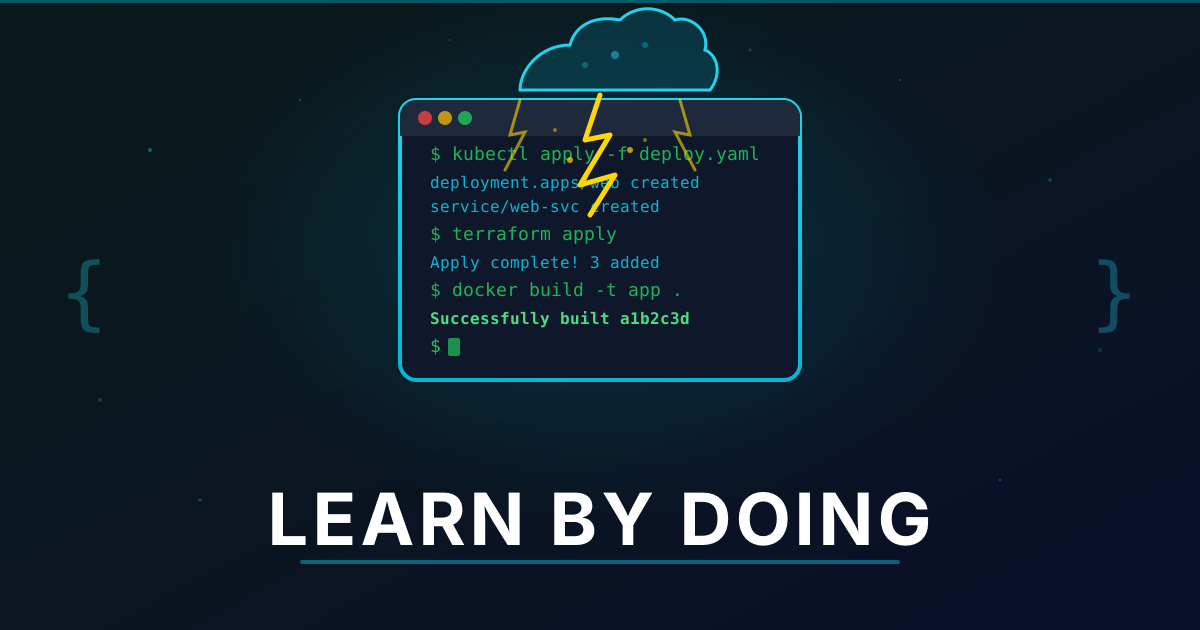
The best time to start hands-on practice is now. Even 20 minutes in a lab environment today is more valuable than planning to start a 40-hour course next month. Open a terminal, pick a service you want to learn, and start building.
Conclusion
The cloud skills gap is not caused by a shortage of educational content. It is caused by a mismatch between how people learn and how cloud skills are taught. Passive content, no matter how well-produced, cannot replicate the experience of deploying, configuring, breaking, and fixing real infrastructure.
The science is clear: hands-on practice produces faster skill acquisition, deeper retention, and greater real-world readiness than any passive learning method. The professionals who advance fastest in cloud careers are those who spend the majority of their learning time with their hands on the keyboard, working in real environments.
AI-generated labs are making this kind of practice more accessible than ever. Instead of being limited to a fixed catalog of pre-authored content, you can generate targeted labs for any technology, at any difficulty level, on demand. The barrier to hands-on practice has never been lower.
Whether you are preparing for a certification, building skills for a career transition, or keeping your expertise current in a rapidly changing field, the path forward is the same: learn by doing.
Want to practice this hands-on?
CloudaQube generates complete labs from a simple description. Try it free.
Get Started Free