The AI engineer is the single fastest-growing technical role in the United States right now. If a software engineer builds software and a data scientist derives insights, an AI engineer ships AI features — taking foundation models like large language models and turning them into real products that customers use. It's a role that barely existed before 2022, and in 2026 it tops every fastest-growing-job list employers publish.
This guide covers the complete AI engineer career path in 2026: what the role actually involves, how it differs from machine learning engineering and data science, the skills employers are hiring for, real salary data by level, and a concrete roadmap to break in — whether you're a software engineer pivoting or starting from scratch.
What Does an AI Engineer Do?
An AI engineer builds systems that use large language models and foundation models as components. Rather than training models from scratch, AI engineers take pre-trained models — from providers like Anthropic, OpenAI, and Cohere — and integrate them into applications that solve real business problems.
The work spans the full lifecycle of an AI feature:
- Designing data pipelines that feed context into models
- Integrating model APIs into web and backend applications
- Building retrieval-augmented generation (RAG) systems so models can answer questions about a company's private data
- Designing and orchestrating AI agents that complete multi-step tasks
- Deploying AI systems to the cloud and monitoring their performance, cost, and reliability
- Making engineering trade-offs around latency, accuracy, cost, and safety
The defining shift in 2026 is that employers aren't hiring for AI knowledge in the abstract — they're hiring strong engineers who can apply AI thoughtfully inside real products. As one industry summary put it, companies want professionals who can manage every aspect of AI systems, "from deployment and monitoring to cost management and AI safety." The systems-first mindset matters more than knowing the math behind transformers.
AI Engineer vs. ML Engineer vs. Data Scientist
These three roles are constantly confused, and picking the wrong target can cost you a year. Here's how they actually differ in 2026:
| Role | Core question | Primary skills | Builds |
|---|---|---|---|
| Data Scientist | "What should we do?" | Statistics, experimentation, predictive modeling | Insights, recommendations, analyses |
| ML Engineer | "How do we run this at scale?" | ML pipelines, model deployment, infrastructure | Production ML systems |
| AI Engineer | "How do we build this into a product?" | LLM integration, prompt engineering, RAG, vector DBs, agents | AI-powered product features |
The history explains the split. "Data scientist" once covered almost everything. Then ML engineering broke off as model deployment became its own discipline. Then generative AI created an entirely new category — the AI engineer — focused on building products on top of foundation models rather than training models from the ground up.
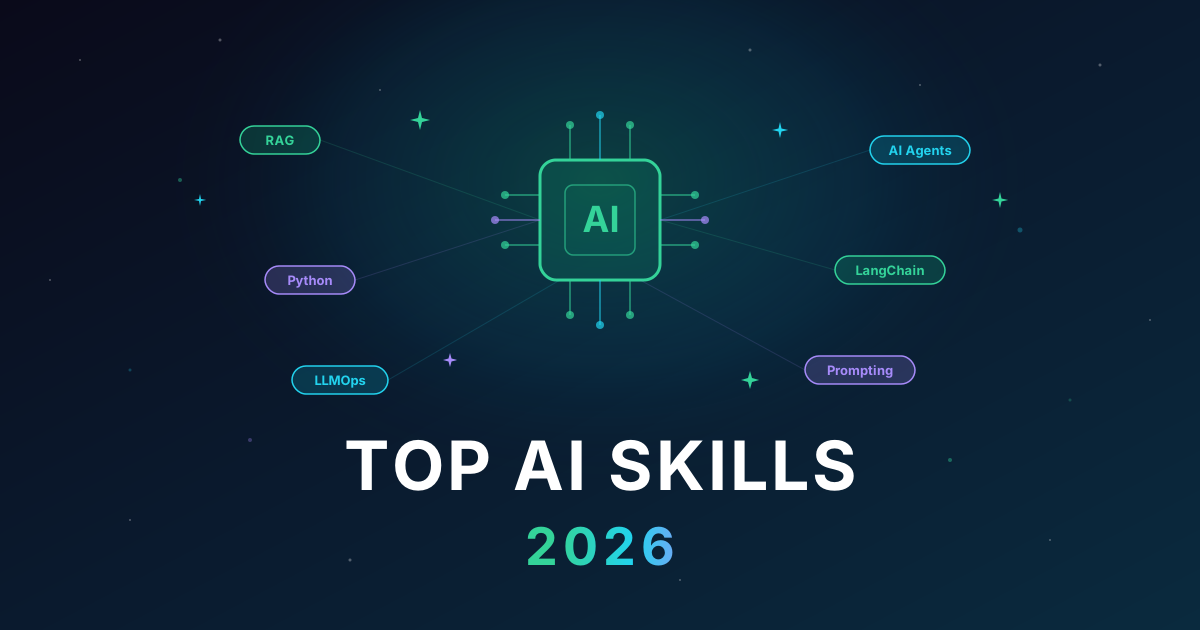
A useful hiring heuristic: reliability and scale of existing ML calls for an ML engineer; building a feature powered by AI calls for an AI engineer; understanding your data to make better decisions calls for a data scientist. LLM-related engineering skills grew in demand by over 400% between 2022 and 2026 — far outpacing the other two roles. If you want to know more about the foundational skills that feed into this path, our guide to the top AI skills to learn in 2026 breaks them down in detail.
The 2026 Job Market: Why Demand Is Exploding
The numbers behind this role are unusually strong:
- AI engineer was LinkedIn's #1 fastest-growing job title in the US in 2026 — and the fastest-growing title for young workers for the second consecutive year.
- Between 2023 and 2025, LinkedIn added 639,000 AI-related US job postings, including 75,000 specifically for AI engineer roles.
- Agentic AI job postings grew 280% year-over-year, with forward-deployed engineer demand up 800%.
- AI-related positions broadly grew 25.2% year-over-year in Q1 2026.
Enterprise adoption is the engine. According to Korn Ferry's 2026 survey of 1,674 global talent leaders, 52% plan to deploy autonomous AI agents by the end of 2026. Among companies that already deployed agents, 88% are increasing their budgets and 66% report measurable productivity gains. The World Economic Forum, citing LinkedIn data, reported that AI has already added 1.3 million jobs.
The takeaway: this isn't a hype cycle that's about to deflate. The talent supply has not caught up with demand, and the gap is widest for engineers who can ship reliable, production-grade systems — not just prototype with a model in a notebook.
AI Engineer Salary in 2026
Salary data varies by source, by whether it measures base or total compensation, and by location — so here's the honest range rather than a single cherry-picked number.
| Level | Base salary | Total compensation |
|---|---|---|
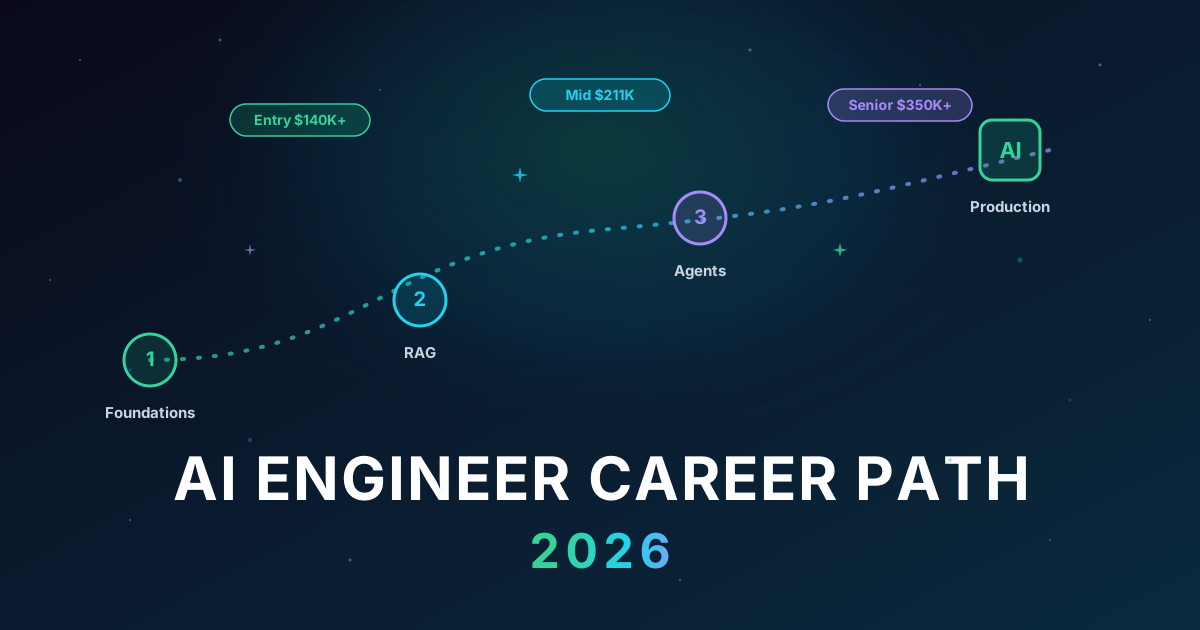
| Entry-level (non-FAANG) | $130,000–$160,000 | $140,000–$175,000 |
| Mid-career | $160,000–$200,000 | $200,000–$245,000 |
| Senior | $200,000–$250,000 | $300,000–$350,000+ |
| Top-tier (Google, Meta, OpenAI) | — | $350,000–$550,000+ |
Key data points across sources:
- The national median sits around $173,000, with average base salary near $184,757.
- Levels.fyi, drawing on 9,500+ self-reported profiles, puts median total compensation at $211,000.
- Glassdoor's average — which skews toward base and includes smaller employers — comes in lower at roughly $143,000.
- Mid-career engineers routinely clear $200,000 in total comp; senior engineers regularly see $300,000–$350,000+.
Two things drive the spread: total comp at top companies is dominated by equity (which is why OpenAI offers can run far higher), and location still matters even in a remote-friendly market. The honest read is that AI engineering pays at or above senior software engineering levels almost everywhere, with a meaningfully higher ceiling.
The Skills Employers Actually Hire For
You don't need every advanced skill at once. Most AI engineer roles in 2026 require strong foundations plus one or two advanced areas. Here's the stack, ordered from foundation to specialization.
Foundation skills (non-negotiable)
- Strong Python. Clean, efficient, production-quality code. This is the language of AI engineering.
- Software engineering fundamentals. APIs, version control, testing, debugging, and how to ship and maintain real applications.
- Cloud and deployment basics. AI features run on AWS, Azure, or GCP. You need to deploy, monitor, and manage cost. If you're light here, our guide on how to break into cloud engineering in 2026 covers the groundwork.
- A working grasp of ML concepts. You don't need to derive backpropagation, but you should understand how models behave, plus enough linear algebra and probability to reason about them.
LLM-specific skills (the differentiators)
- Prompt engineering. Getting reliable, structured output from models.
- RAG (retrieval-augmented generation). The single most in-demand pattern. Every company has proprietary data that generic LLMs know nothing about, and RAG is how you make AI useful with it. Start with our walkthrough of what RAG is and how to build it with LangChain and Pinecone.
- Vector databases. Pinecone, Weaviate, Qdrant, Chroma — the storage layer for RAG and semantic search.
- Orchestration frameworks. LangChain, LlamaIndex, and increasingly agent frameworks.
- Agent architectures. The fastest-growing specialization. Designing systems that plan, call tools, and complete multi-step tasks. This is where the 280% job growth is concentrated.
Production skills (what separates senior from junior)
- MLOps and observability. Monitoring quality, latency, drift, and failures in production.
- Containerization. Docker and Kubernetes for packaging and scaling AI workloads.
- Cost management. LLM API calls add up fast; making smart trade-offs around model choice and caching is a core engineering responsibility.
- AI safety and evaluation. Guardrails, evals, and handling the failure modes of non-deterministic systems.
The Roadmap: How to Break In
Engineers with 2–5 years of software experience can pivot into AI roles within 1–2 years by following a structured approach. Here's a realistic timeline for someone studying part-time alongside a job.
Months 1–3: Foundations
Master Python fundamentals and the core libraries. Get comfortable calling model APIs and handling their output. If you're coming from a non-software background, this phase takes longer — don't rush it, because everything else builds on it.
Months 4–6: First portfolio projects
Build something real that uses an LLM. A document Q&A tool, a customer-support assistant, a code reviewer — anything that takes a model and turns it into a working application. The goal is a project you can demo and explain, not a tutorial you followed.
Months 7–9: RAG and retrieval
Learn to build RAG systems end to end: chunking, embeddings, a vector database, retrieval, and grounded generation. This is the skill most hiring managers screen for. Rebuild your month-4 project with RAG so it can answer questions about real, private data. If you want structured practice for this phase, our AI & Machine Learning courses include hands-on labs for RAG pipelines, LLM fine-tuning, and agent development.
Months 10–12+: Agents and production
Move from "AI answers questions" to "AI completes tasks." Build an agent that plans and calls tools. Then focus on the production layer — deploying to the cloud, monitoring, evaluating output quality, and controlling cost. Companies need engineers who can ship reliable systems at scale, not just train models.
The credential vs. experience reality
Data shows AI engineers with strong portfolios have 40% higher interview callback rates than those relying solely on credentials. Certifications help signal commitment and structure your learning — the AWS Generative AI / AI Practitioner certifications are a reasonable on-ramp — but they're a complement to a portfolio, never a substitute. What gets you hired is a body of working systems that demonstrate business value.
Common Mistakes to Avoid
- Trying to learn everything first. You'll burn out before you ship anything. Pick a project and learn what it requires.
- Chasing model training when companies want product builders. The dominant demand is for engineers who integrate and deploy models, not those who train them from scratch.
- Skipping the production layer. Anyone can get an impressive demo in a notebook. Engineers who can deploy, monitor, and cost-control AI systems are the ones who get paid.
- Building only tutorials. Following along teaches syntax, not problem-solving. Ship original projects, even small ones.
- Ignoring cloud fundamentals. AI runs on cloud infrastructure. Weak cloud skills cap your effectiveness and your salary.
How to Build These Skills Faster
The fastest learners don't just read about AI engineering — they build, break, and fix systems repeatedly. Every project you ship is both a skill multiplier and a portfolio entry you can walk an interviewer through.
The blocker for most people is environment setup and cost: spinning up cloud infrastructure, wiring up a vector database, and experimenting with deployment without racking up surprise bills. CloudaQube's hands-on labs give you sandboxed environments to build RAG pipelines, deploy AI services, and practice the exact production skills employers screen for — without worrying about a runaway cloud bill.
The Bottom Line
The AI engineer career path in 2026 is one of the strongest opportunities in tech. Demand is outpacing supply, salaries sit at or above senior software engineering levels with a much higher ceiling, and the role rewards builders over credential-collectors. You don't need a PhD or a research background — you need strong Python, software engineering fundamentals, and a portfolio of working AI systems.
The path is clear: build foundations, ship real projects, master RAG, move into agents and production, and document everything you build. The engineers winning these roles aren't the ones who know the most theory — they're the ones who can ship reliable AI features that solve real problems.
Start today. Pick a project. Wire up a model. Ship it. That's how AI engineering careers are built.
Frequently Asked Questions
How much does an AI engineer make in 2026?
AI engineer base salaries in the US range from roughly $140,000 to $185,000 in 2026, with a national median around $173,000. Total compensation is higher: mid-career engineers routinely clear $200,000, and senior engineers at top companies reach $300,000–$350,000+. Levels.fyi data puts median total compensation around $211,000.
Do I need a degree to become an AI engineer?
No. Many AI engineers come from non-traditional backgrounds and break in through online courses, hands-on projects, and a strong portfolio. Data shows engineers with strong portfolios get 40% higher interview callback rates than those relying on credentials alone. What matters most is a portfolio of working AI systems that demonstrate business value.
What is the difference between an AI engineer and a machine learning engineer?
An AI engineer builds product features on top of existing foundation models (LLMs) using prompt engineering, RAG, vector databases, and agent frameworks — they answer "how do we build this into a product?" A machine learning engineer focuses on training, deploying, and scaling custom ML models in production — they answer "how do we run this reliably at scale?" The roles overlap, but the AI engineer role barely existed before 2022.
How long does it take to become an AI engineer?
If you already have software engineering experience, a focused 1–2 year transition is realistic. A common structured timeline is: Python and core ML libraries in months 1–3, first portfolio projects in months 4–6, RAG systems in months 7–9, and production deployment after that. Starting from zero takes longer, but the fastest path always centers on shipping real projects.
Is it too late to become an AI engineer in 2026?
No. AI engineer was LinkedIn's #1 fastest-growing job title in the US for the second consecutive year in 2026, and agentic AI job postings grew 280% year-over-year. The talent supply has not caught up with demand, especially for engineers who can ship reliable, production-grade AI systems rather than just prototype with models.