The Honest Truth About the 2026 Cloud Job Market
Let's address the elephant in the room: entry-level tech jobs are harder to land than they were three years ago. Mass layoffs, hiring freezes, and AI-driven productivity gains have compressed headcounts at many companies. If you're scrolling through job boards and feeling like every "junior" role requires three years of experience, you're not imagining things.
But here's the nuance that most doom-and-gloom articles miss: cloud infrastructure spending is still accelerating. Global cloud spend crossed $900 billion in 2025 and is projected to exceed $1.1 trillion by the end of 2026. Companies aren't cutting cloud budgets. They're cutting the number of people who manage those budgets, which means they need each remaining engineer to be more capable, not less.
The bar has risen. That's the bad news. The good news is that the bar is clearable if you know exactly what to build, what to learn, and how to present yourself. This article is the roadmap.
Who This Guide Is For
This guide is written for two groups:
- Career changers coming from other fields (teaching, finance, healthcare, retail, military) who want to break into cloud engineering without a CS degree.
- Early-career technologists (recent grads, help desk, IT support) who want to move up the stack into cloud infrastructure roles.
If you've been told you need a four-year computer science degree to work in cloud, that's outdated advice. Some of the strongest cloud engineers working today came from non-traditional backgrounds. What matters is demonstrable skill, and demonstrable skill can be built in 12 months with the right plan.
The Skills That Actually Get You Hired
Not all cloud skills are created equal. Here's what hiring managers consistently look for in 2026, ranked by priority.
Tier 1: Non-Negotiable Foundations
- Linux administration: Navigating the filesystem, managing processes, editing files with vim or nano, understanding permissions, working with systemd. Most cloud workloads run on Linux. If you can't troubleshoot a Linux server, nothing else matters.
- Networking fundamentals: TCP/IP, DNS, HTTP/HTTPS, subnets, CIDR notation, firewalls, load balancers. You don't need a CCNA, but you need to understand how packets get from point A to point B.
- One major cloud platform (AWS preferred): Core services including compute (EC2, Lambda), storage (S3, EBS), networking (VPC, security groups, route tables), and identity (IAM). AWS still dominates the job market at roughly 31% market share, followed by Azure at 25%.
- Infrastructure as Code: Terraform is the industry default. Learn it well enough to provision a VPC, deploy EC2 instances, configure security groups, and manage state files. Our comparison of Terraform, CloudFormation, and Pulumi covers the tradeoffs.
Tier 2: High-Value Differentiators
- Containers and orchestration: Docker for building and running containers. Kubernetes for orchestrating them. You don't need to be a Kubernetes expert on day one, but you need to understand pods, deployments, services, and how to use kubectl. See our Docker and Kubernetes orchestration guide for a deeper dive.
- CI/CD pipelines: GitHub Actions is the most commonly used CI/CD tool for new projects. Know how to write a workflow that builds, tests, and deploys an application.
- Git: Branching, merging, pull requests, resolving conflicts. This is table stakes, but a surprising number of candidates fumble it.
- Scripting: Bash for automation and Python for anything more complex. You don't need to be a software engineer, but you need to be able to write a script that automates a repetitive task.
Tier 3: Valuable But Learnable on the Job
- Monitoring and observability: Prometheus, Grafana, CloudWatch. Know the concepts (metrics, logs, traces, alerting) even if you haven't built production monitoring stacks.
- Security fundamentals: Least privilege, secret management, encryption at rest and in transit, compliance basics.
- Cost optimization: Understanding reserved instances, spot instances, right-sizing, and how cloud billing works.
Focus Your Energy
If you're just starting out, spend 80% of your time on Tier 1 skills. Many candidates spread themselves too thin across dozens of services and tools. An applicant who can confidently deploy and troubleshoot a three-tier application on AWS with Terraform will beat someone who has surface-level familiarity with 15 different services.
Which Certifications Actually Matter
Certifications alone won't get you hired. But the right certification combined with a strong portfolio signals that you're serious and have a baseline of verified knowledge. Here's what's worth your time in 2026.
High ROI Certifications
| Certification | Cost | Value | Best For |
|---|---|---|---|
| AWS Solutions Architect Associate (SAA-C03) | $150 | Very High | Anyone targeting AWS roles. The most recognized cloud cert in the industry. |
| AWS Cloud Practitioner (CLF-C02) | $100 | Moderate | Complete beginners who need a confidence boost before SAA. Skip it if you can go straight to SAA. |
| Terraform Associate (003) | $70 | High | Proving IaC competency. Pairs well with any cloud cert. |
| CKA (Certified Kubernetes Administrator) | $395 | High | Roles that involve container orchestration. A hands-on exam that employers trust. |
| CompTIA Linux+ | $369 | Moderate | Career changers who need to prove Linux competency. |
For a detailed certification strategy, check our AWS certifications roadmap for 2026 and CKA certification study guide.
The Certification Trap
Do not collect certifications like Pokemon cards. Two relevant certs plus a strong portfolio beats five certs and no hands-on evidence. Hiring managers have seen too many candidates with impressive cert lists who can't troubleshoot a broken deployment. Certifications open doors; your portfolio proves you can walk through them.
Salary Ranges by Role (2026, US Market)
Understanding what different cloud roles pay helps you set realistic targets and plan your progression.
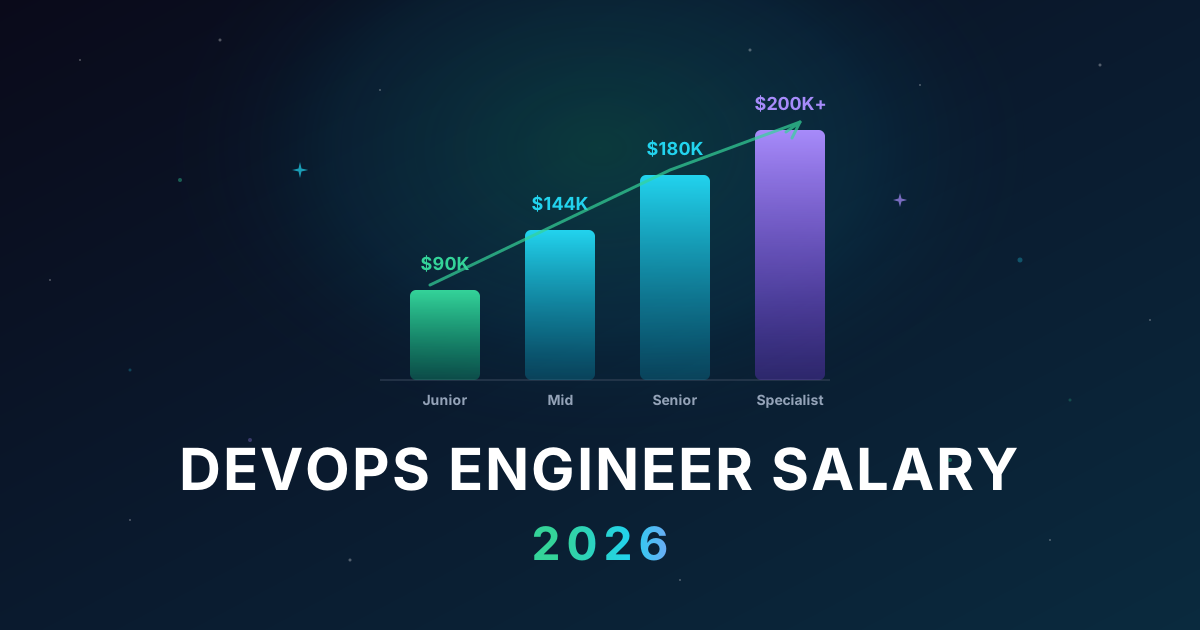
| Role | Experience | Salary Range (USD) |
|---|---|---|
| Cloud Support Engineer | 0-2 years | $65,000 - $90,000 |
| Junior Cloud Engineer | 0-2 years | $75,000 - $105,000 |
| Cloud Engineer | 2-5 years | $110,000 - $150,000 |
| Senior Cloud Engineer | 5-8 years | $150,000 - $190,000 |
| DevOps Engineer | 2-5 years | $120,000 - $160,000 |
| Cloud Architect | 5+ years | $160,000 - $220,000 |
| Site Reliability Engineer | 3-6 years | $140,000 - $200,000 |
| Platform Engineer | 3-6 years | $135,000 - $185,000 |
These ranges vary significantly by geography, company size, and industry. Fully remote roles from major tech companies tend toward the upper end. Regional companies and startups often sit at the lower to mid range but may offer faster career progression.
The 12-Month Roadmap
Here's a month-by-month plan that takes you from zero to job-ready. Adjust the pace based on how many hours per week you can dedicate. This plan assumes 15-20 hours per week. If you're doing this full-time, you can compress it to 6-8 months.
Months 1-3: Build the Foundation
Goal: Get comfortable with Linux, networking, and core AWS services.
Month 1: Linux and Networking
- Install Ubuntu (dual-boot, VM, or WSL2) and use it as your daily driver for learning
- Work through the Linux filesystem, permissions, users/groups, package management, systemd services
- Learn networking fundamentals: IP addressing, subnets, DNS resolution, TCP vs. UDP, HTTP request lifecycle
- Practice: Set up an Nginx web server on a Linux VM and make it accessible from your browser
Month 2: AWS Core Services
- Create a free-tier AWS account
- Learn IAM: users, groups, roles, policies. Understand the principle of least privilege
- Deploy EC2 instances: launch, connect via SSH, install software, configure security groups
- Work with S3: create buckets, upload files, configure bucket policies, enable static website hosting
- Understand VPC networking: subnets, route tables, internet gateways, NAT gateways
Month 3: Infrastructure as Code with Terraform
- Install Terraform and learn the core workflow: init, plan, apply, destroy
- Reproduce everything you built manually in Months 1-2 using Terraform
- Learn state management, variables, outputs, and modules
- Build your first complete project: a VPC with public/private subnets, an EC2 instance, a security group, and an S3 bucket, all defined in Terraform
The Hands-On Imperative
Do not just read about these services. Build them. Break them. Fix them. Every hour spent in a terminal is worth five hours watching videos. If you need structured lab environments, hands-on cloud labs are the fastest way to build real muscle memory.
Months 4-6: Level Up and Certify
Goal: Add containers, CI/CD, and earn your first certification.
Month 4: Docker and CI/CD
- Learn Docker: images, containers, Dockerfiles, volumes, networking, Docker Compose
- Containerize a simple application (a Python Flask app or a Node.js API)
- Set up a GitHub Actions workflow that builds and tests your application on every push
- Extend the pipeline to build a Docker image and push it to a container registry
Month 5: AWS Solutions Architect Associate Prep
- Begin structured SAA-C03 exam preparation
- Study the core domains: compute, storage, networking, databases, security, high availability
- Take practice exams weekly and review every wrong answer thoroughly
- Continue building in AWS alongside your study. Every concept you encounter, deploy it
Month 6: Certification and First Portfolio Project
- Take and pass the AWS SAA-C03 exam
- Build your first portfolio project: a three-tier web application deployed on AWS using Terraform, with a CI/CD pipeline. Our guide to deploying a three-tier architecture with Terraform walks through this exact scenario
- Document the project in a GitHub repository with a clear README, architecture diagram, and deployment instructions
Months 7-9: Specialize and Build Your Portfolio
Goal: Add Kubernetes skills, build 2-3 portfolio projects, and start networking.
Month 7: Kubernetes
- Learn Kubernetes concepts: pods, deployments, services, config maps, secrets, namespaces
- Deploy applications to a local cluster using minikube or kind
- Write Kubernetes manifests and learn Helm basics
- Practice kubectl commands until they're muscle memory
Month 8: Portfolio Project #2
- Build a project that demonstrates Kubernetes skills: deploy a microservices application with multiple services communicating over a service mesh or simple HTTP
- Add monitoring with Prometheus and Grafana
- Include a CI/CD pipeline that deploys to Kubernetes
- Push everything to GitHub with thorough documentation
Month 9: Portfolio Project #3 + Networking
- Build a project that solves a real problem. Ideas:
- A serverless data pipeline that ingests, transforms, and stores data
- An automated infrastructure compliance checker using Python and AWS APIs
- A cost monitoring dashboard that tracks and alerts on AWS spending
- Start attending local meetups (AWS User Groups, DevOps meetups, KubeCon watch parties)
- Create or update your LinkedIn profile with your new skills, certs, and project links
- Begin contributing to open-source projects (even documentation fixes count)
Months 10-12: Job Search Sprint
Goal: Land your first cloud role.
Month 10: Resume and Interview Prep
- Rewrite your resume to lead with projects and skills, not just employment history. Career changers: your previous experience is an asset, not a liability. Frame it as domain expertise
- Practice the STAR method for behavioral interviews (Situation, Task, Action, Result)
- Prepare answers for common cloud interview scenarios: "How would you design a highly available web application?" "Walk me through how you'd troubleshoot a 503 error." "How does a VPC work?"
- Study system design basics: load balancing, caching, database replication, CDNs
Month 11: Active Applications
- Apply to 10-15 roles per week. Target: Cloud Engineer, Junior DevOps Engineer, Cloud Support Engineer, Infrastructure Engineer
- Customize your cover letter for each application. Mention specific technologies from the job description and link to relevant portfolio projects
- Reach out to people at target companies on LinkedIn. Not cold pitches. Genuine questions about the team, the tech stack, or the culture
- Continue building and learning. Stagnation shows
Month 12: Interview, Iterate, Land
- Treat every interview as practice, even for roles you're not sure about
- After each interview, write down every question you were asked and refine your answers
- If you're getting interviews but not offers, the gap is likely in your technical depth or communication. Practice more hands-on scenarios and rehearse explaining your projects out loud
- Consider contract or freelance work as a bridge. Many cloud careers start with a 6-month contract that converts to full-time
Career Changers: Your Experience Is Valuable
If you're transitioning from another field, don't hide your background. A former teacher who can explain complex technical concepts clearly, a former nurse who understands compliance and documentation, a former retail manager who knows how to prioritize under pressure -- these are real advantages. Frame your previous career as complementary to your cloud skills, not separate from them.
Building a Portfolio That Gets Interviews
Your portfolio is more important than your resume. Here's what makes a portfolio stand out.
What Hiring Managers Look For
- Real infrastructure, not just code: Terraform configs, Kubernetes manifests, CI/CD pipelines, architecture diagrams. Not just application code.
- Documentation: A clear README that explains what the project does, why you built it, the architecture decisions you made, and how to deploy it. This demonstrates communication skills.
- Version control discipline: Meaningful commit messages, feature branches, pull requests. Show that you work like a professional.
- Progressive complexity: Three projects that show growth from simple to complex is better than one massive project that's hard to evaluate.
Portfolio Project Ideas
- Production-grade static site: S3 + CloudFront + Route 53 + ACM certificate, all provisioned with Terraform, deployed via GitHub Actions. Simple but demonstrates real infrastructure skills.
- Containerized microservices: Two or three services deployed on ECS or Kubernetes, with a load balancer, health checks, auto-scaling, and centralized logging.
- Infrastructure monitoring stack: Deploy Prometheus and Grafana on Kubernetes, configure scraping for a sample application, create dashboards and alerting rules.
- Serverless data pipeline: API Gateway + Lambda + DynamoDB or S3 + EventBridge, processing data and storing results with proper error handling and dead-letter queues.
- Automated CI/CD pipeline with GitHub Actions, Docker, and AWS: A complete pipeline that lints, tests, builds, and deploys an application with staging and production environments.
Networking Strategies That Work
Networking feels awkward. Here's how to do it without being that person.
Contribute before you ask. Answer questions in Discord servers, Slack communities, and forums. Write blog posts about what you're learning. Share your projects. Build a reputation as someone who adds value.
Be specific in outreach. "I'd love to pick your brain" is vague and off-putting. "I noticed your team uses Terraform with GitHub Actions for deployments. I've been building something similar for my portfolio and had a question about state management" is specific and shows genuine interest.
Target these communities:
- Local AWS/Azure/GCP user group meetups
- KubeCon, HashiConf, and re:Invent (even virtual attendance and watch parties)
- Reddit r/devops, r/aws, r/cloudcomputing
- Dev.to, Hashnode for publishing your own content
- Discord communities for DevOps and cloud (many certification study groups exist)
Referrals are the highest-conversion application method. 40-60% of hires at many tech companies come through referrals. Every person you genuinely connect with is a potential referral source.
Interview Preparation
Technical Interview Topics
Expect questions across these areas:
- Scenario-based design: "Design a system that handles 10,000 requests per second with 99.9% uptime"
- Troubleshooting walkthroughs: "A user reports they can't reach the application. Walk me through your debugging process"
- Service-specific knowledge: IAM policies, VPC architecture, S3 access patterns, ECS vs. EKS tradeoffs
- IaC concepts: Terraform state management, modules, how to handle drift, secrets in IaC
- Linux and networking: "What happens when you type a URL into a browser?" "How would you diagnose high CPU usage on a Linux server?"
How to Practice
- Build, break, and fix things daily. This is the single highest-ROI activity for interview prep. Every troubleshooting session in a lab environment is a potential interview answer.
- Practice explaining your projects out loud. Record yourself walking through an architecture diagram. If you can't explain it clearly in three minutes, simplify.
- Mock interviews with peers. Find a study partner and take turns asking each other questions.
- Write up your projects as case studies. "Problem I solved, approach I took, challenges I hit, results I achieved." This structure works for both interviews and portfolio documentation.
Frequently Asked Questions
Do I need a computer science degree to become a cloud engineer?
No. While a CS degree can help, it's neither necessary nor sufficient. Many successful cloud engineers have degrees in unrelated fields or no degree at all. What matters is demonstrable skill: certifications, portfolio projects, and the ability to solve problems in live environments. If you can deploy, troubleshoot, and explain cloud infrastructure, your educational background is secondary.
How long does it realistically take to get a cloud engineering job?
For someone dedicating 15-20 hours per week, expect 9-15 months from starting to learn to landing a role. If you're studying full-time, 6-9 months is realistic. The biggest variable isn't study time but job search effectiveness. Many people are job-ready months before they land a role because they're applying ineffectively.
Should I learn AWS, Azure, or Google Cloud?
Start with AWS. It has the largest market share, the most job postings, and the most community resources. Once you're proficient in one cloud platform, the concepts transfer. You can add Azure or GCP knowledge later, and many employers value multi-cloud awareness even if they primarily use one provider.
Is cloud engineering being replaced by AI?
AI is changing cloud engineering, not replacing it. Tools like AI-powered IaC generators, automated remediation, and intelligent monitoring are making cloud engineers more productive. But someone still needs to design architectures, make tradeoff decisions, handle incidents, and ensure security and compliance. If anything, AI is raising the floor on what's expected of cloud engineers, which makes real hands-on skills more valuable, not less.
What if I can't afford cloud lab costs?
AWS Free Tier covers most learning scenarios for 12 months. Terraform is free and open-source. Docker and Kubernetes (via minikube or kind) run locally at no cost. For structured practice without billing surprises, platforms like CloudaQube provide sandboxed lab environments where you can experiment without worrying about unexpected charges.
What's the best first role to target?
Cloud Support Engineer and Junior Cloud/DevOps Engineer roles are the most accessible entry points. Cloud Support roles at AWS, Azure, or GCP are particularly good launchpads because they expose you to a massive variety of services and real customer problems. Don't overlook internal IT roles at companies undergoing cloud migration either. Being the person who leads a migration from on-prem to cloud is career-defining experience.
The Bottom Line
Breaking into cloud engineering in 2026 is harder than it was in 2020. The bar is higher, the competition is stiffer, and you can't coast on a certification alone. But the demand for skilled cloud professionals hasn't gone away. It's evolved. Companies need people who can actually build and troubleshoot infrastructure, not just talk about it.
The 12-month roadmap in this guide gives you a concrete path: build foundational skills, earn a relevant certification, create a portfolio that demonstrates real competency, and network your way into conversations with hiring managers. There's no shortcut, but there is a clear route.
Start today. Open a terminal. Deploy something. Break it. Fix it. That's how cloud careers are built.
Want to practice this hands-on?
CloudaQube generates complete labs from a simple description. Try it free.
Get Started Free