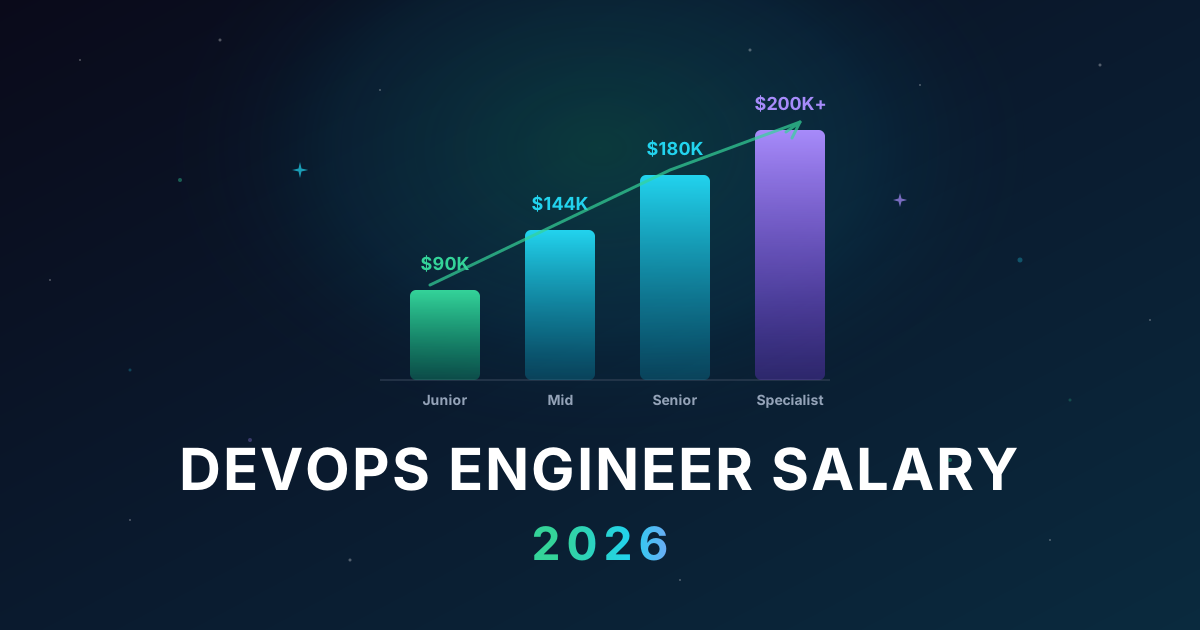
The average DevOps engineer salary in the United States sits between $130,000 and $144,000 in base pay as of 2026, with senior engineers averaging around $180,000 and routinely clearing $200,000 in total compensation. But that single number hides enormous variation — your actual DevOps engineer salary in 2026 depends heavily on your experience level, the certifications you hold, where you work, and which specialization you move into.
This guide breaks down the real numbers from current 2026 salary data: pay by level (junior to senior), the certifications and skills that actually move your salary, the highest-paying cities, how remote compares to onsite, and the specializations — platform engineering, SRE, DevSecOps — that command the biggest premiums. Every figure below is sourced from 2026 compensation data.
DevOps Engineer Salary by Experience Level
Experience is the single biggest driver of base pay. Here's how the DevOps engineer salary scales across levels in 2026:
| Level | Typical base salary | Notes |
|---|---|---|
| Junior / Entry-level | $75,000–$100,000 | Often a converted SysAdmin, support, or new-grad role |
| Mid-level | $100,000–$150,000 | The largest band; most postings target this tier |
| Senior | $150,000–$225,000+ | Average ~$180,500; 75th percentile ~$223,000 |
| Principal / Staff | $200,000–$280,000+ | Seattle data shows principal roles reaching $280,000 |
A few data points worth anchoring on:
- The national average lands around $144,141 per year (~$69/hour), with the broad market spanning roughly $116,000 (25th percentile) to $181,000 (75th percentile).
- Junior DevOps engineers average closer to $72,000 nationally, though structured junior roles at well-funded companies start at $75,000–$100,000.
- Senior DevOps engineers average $180,503, with the typical range running $147,929 to $223,203.
The jump from mid-level to senior is where compensation accelerates most — and it's driven less by years served than by demonstrated depth in cloud, Kubernetes, and reliability engineering. If you're still earlier in the journey, our guide on how to break into cloud engineering in 2026 covers the on-ramp.
How Certifications Move Your DevOps Salary
Certifications are one of the most reliable levers on a DevOps engineer salary in 2026 — not because a badge alone earns more, but because the right certs filter you into higher-paying tiers and signal verified skill.
AWS certifications
AWS skills carry the largest single premium. ZipRecruiter data puts certified AWS DevOps engineers averaging around $154,038, with top earners at $183,500 — well above the general DevOps average. The AWS Certified DevOps Engineer – Professional and Solutions Architect credentials are the most commonly requested in $140K+ postings.
Kubernetes (CKA / CKAD)
The CKA and CKAD add roughly a $15K–$25K premium for container-orchestration roles. The CKA is a hands-on practical exam rather than multiple choice, so companies running production Kubernetes filter for it specifically — passing it proves real operational ability, not just memorization. If you're weighing which Kubernetes cert to pursue, our CKA vs CKAD vs CKS comparison lays out which one to get first.
Terraform and IaC
Terraform now appears in roughly two-thirds of DevOps job postings. The dynamic has flipped: it's become expected rather than impressive, which means not having production-level Terraform hurts before having it earns you much. Treat it as table stakes, not a differentiator.
The real lesson: stack your skills
The biggest salary gains don't come from any single certification. They come from combinations:
- AWS alone → solid mid-level pay
- AWS + production Kubernetes → mid-level engineers regularly hit $145K–$165K
- AWS + Terraform + security + SRE experience → the top of the senior band
Specialization moves salary more than collecting badges. One deep, verifiable skill stack beats five shallow certs every time. If you're building that stack, our hands-on DevOps & CI/CD courses cover Docker, GitHub Actions, and platform engineering with real pipelines — the verifiable skills these salary tiers filter for.
DevOps Engineer Salary by Location
Where you work still shapes the headline number, even in a remote-friendly market. Here's how major US metros compare in 2026:
| Location | Average DevOps salary | vs. national |
|---|---|---|
| San Francisco, CA | ~$183,092 | +28% |
| New York, NY | ~$154,975 | +8% |
| Seattle, WA | ~$132,938 | near baseline (no state income tax) |
| National average | ~$144,141 | baseline |
San Francisco leads on paper, with mid-level salaries running $161,000–$199,000. But Seattle deserves a closer look: Washington has no state income tax, so a DevOps engineer earning $175K in Seattle takes home more than the same salary in San Francisco or New York. Sticker price isn't take-home pay.
Remote vs. Onsite: The Gap Is Smaller Than You Think
One of the clearest trends in 2026 is how well remote DevOps pay holds up. According to CareerCheck data, the remote DevOps median sits around $149,623, with the range running $125,451 to $173,795 — competitive with onsite roles in most US cities and actually above the national average.
Why? DevOps talent is scarce enough that many companies can't afford aggressive location-based pay adjustments. Plenty of remote roles pay at or near New York rates regardless of where the engineer lives. Pair that with a lower cost of living, and remote often wins on real, after-tax, after-rent income — even when the onsite SF posting shows a bigger number.
The practical implication for your job search: don't anchor on the highest sticker number. A $185K San Francisco offer and a $150K remote role in a lower-cost metro can leave you with nearly identical disposable income once rent and state taxes are accounted for — and the remote role often comes with more flexibility. Run the take-home math on every offer, not just the headline figure, and weight specialization and skill growth at least as heavily as the base salary, since those compound over your whole career.
The Highest-Paying DevOps Specializations in 2026
If you want to raise your DevOps engineer salary fast, moving into a specialization is the highest-leverage play. Here's how the adjacent roles stack up:
| Specialization | Average salary (2026) | vs. standard DevOps |
|---|---|---|
| Platform Engineering | ~$172,038 | +~20% |
| SRE (Site Reliability) | ~$160,000+ | +~15% |
| DevSecOps (senior) | $165,000–$204,000 | top tier |
| Standard DevOps | ~$144,141 | baseline |
- Platform engineering is the top-paying track, averaging ~$172,000 — about 20% above standard DevOps and even slightly ahead of SRE. The rise of internal developer platforms is driving this premium; see our deep dive on platform engineering and internal developer portals.
- SRE sits just below platform engineering, with reliability and on-call expertise commanding a clear bump over generalist DevOps.
- DevSecOps pays at the top end for senior roles, with remote senior engineers reaching $204,000+ as security shifts left into the pipeline.
The pattern is consistent: the further you move from "generalist who keeps the pipeline running" toward "specialist who owns reliability, security, or developer experience," the higher the ceiling.
Job Outlook: Is DevOps Still Worth It in 2026?
Yes — and the trajectory is strong. The Bureau of Labor Statistics projects 25%+ growth in software and operations roles through 2033. Several forces are pushing demand higher:
- Continued cloud-native application adoption
- The platform engineering movement creating new, better-paid roles
- DevSecOps requirements as security shifts into the pipeline
- AI/ML operations (MLOps, LLMOps) spawning entirely new specialties
DevOps engineers remain among the best-paid individual contributors in tech, and the role keeps branching into higher-paying specializations rather than saturating. AI tooling is raising the floor on productivity, not replacing the judgment required to design systems, handle incidents, and make architectural trade-offs.
How to Increase Your DevOps Salary
Pulling the data together, here are the highest-ROI moves to raise your number in 2026:
- Get deep on one cloud, then certify. AWS first — it has the most postings and the clearest salary premium.
- Run production Kubernetes and pass the CKA. That's a $15K–$25K swing and a tier filter for senior roles.
- Make Terraform table stakes. You won't get paid extra for it, but you'll be screened out of $140K+ roles without it.
- Specialize into platform engineering, SRE, or DevSecOps. This is the single biggest lever — worth 15–20%+ over generalist DevOps.
- Treat remote as a real option. With a ~$150K median and lower cost of living, remote frequently beats a higher-on-paper onsite offer.
- Build a portfolio that proves it. Hiring managers pay for demonstrated ability, not claimed experience.
That last point is where most engineers stall. You can read about Kubernetes and Terraform endlessly, but the engineers who command top-of-band salaries are the ones who can show working systems and talk through real incidents.
Build the Skills That Command the Salary
Every salary lever in this guide — AWS depth, production Kubernetes, Terraform, SRE practices — comes down to one thing: hands-on ability you can prove. The fastest way to build it is to deploy real infrastructure, break it, and fix it, repeatedly.
CloudaQube's hands-on cloud labs give you sandboxed environments to provision infrastructure with Terraform, run Kubernetes clusters, build CI/CD pipelines, and practice the exact skills that move you up the salary bands — without racking up a surprise cloud bill. Pair the labs with the certifications that filter you into higher tiers, and you turn a guide full of numbers into your own offer letter.
The DevOps salary ranges in this guide are real and within reach. The engineers who hit the top of them aren't the ones who read the most — they're the ones who built, certified, and specialized. Start building today.
Frequently Asked Questions
What is the average DevOps engineer salary in 2026?
The average DevOps engineer salary in the US is roughly $130,000–$144,000 in base pay as of 2026, with a typical range between about $116,000 (25th percentile) and $181,000 (75th percentile). Total compensation runs higher once bonuses and equity are included. Senior engineers average around $180,000 and frequently clear $200,000.
How much do certifications increase a DevOps engineer's salary?
Certifications meaningfully move pay. ZipRecruiter data puts certified AWS DevOps engineers averaging around $154,000, well above the general DevOps average. A Kubernetes CKA/CKAD adds roughly a $15K–$25K premium for container-orchestration roles. The biggest gains come from stacking skills — AWS plus Kubernetes plus security pays more than any single cert alone.
Which DevOps specialization pays the most in 2026?
Platform engineering is the top-paying DevOps specialization in 2026, averaging around $172,000 — about 20% above standard DevOps roles. Site Reliability Engineering (SRE) and DevSecOps follow closely, with senior DevSecOps roles reaching $200,000+. Moving into one of these specializations is the single highest-leverage way to raise your DevOps salary.
Do remote DevOps jobs pay less than onsite roles?
Not by much. Remote DevOps median sits around $149,600 in 2026, competitive with onsite roles in most US cities. DevOps talent is scarce enough that many companies pay near New York rates regardless of location, so remote roles often win on take-home pay once cost of living is factored in.
Is DevOps still a good career in 2026?
Yes. The Bureau of Labor Statistics projects 25%+ growth in software and operations roles through 2033, and demand is being pushed further by cloud-native adoption, platform engineering, DevSecOps, and AI/ML operations. DevOps engineers remain among the best-paid individual contributors in tech, with clear paths into even higher-paying specializations.