DevOps Has a Scaling Problem
DevOps promised a world where developers own the full lifecycle of their applications — from code to production. The reality at most organizations is different. Developers drown in operational complexity. Instead of writing features, they're debugging Terraform modules, configuring Kubernetes manifests, setting up CI/CD pipelines, and navigating a maze of cloud services they don't fully understand.
The result: cognitive overload, slow onboarding, and a growing backlog of "DevOps tickets" that bottleneck every engineering team.
Platform engineering solves this by creating an abstraction layer between developers and infrastructure. Instead of every team learning Kubernetes, Terraform, and AWS from scratch, a dedicated platform team builds self-service tools that let developers deploy, monitor, and manage their applications through a curated experience.
Gartner predicts that 80% of software engineering organizations will establish platform teams by 2026. Yet despite the hype, almost no quality educational content exists on how to actually build a platform. This guide changes that.
What Is Platform Engineering?
Platform engineering is the discipline of designing and building toolchains and workflows that enable software engineering teams to self-serve their infrastructure needs. The core output is an Internal Developer Platform (IDP) — a layer of tools, APIs, and documentation that abstracts infrastructure complexity into reusable, standardized workflows.
The key distinction from traditional DevOps: platform engineering treats the platform as a product, with internal developers as its customers. Platform teams gather requirements, build features, measure adoption, and iterate — just like a product team building for external users.
The Internal Developer Platform Stack
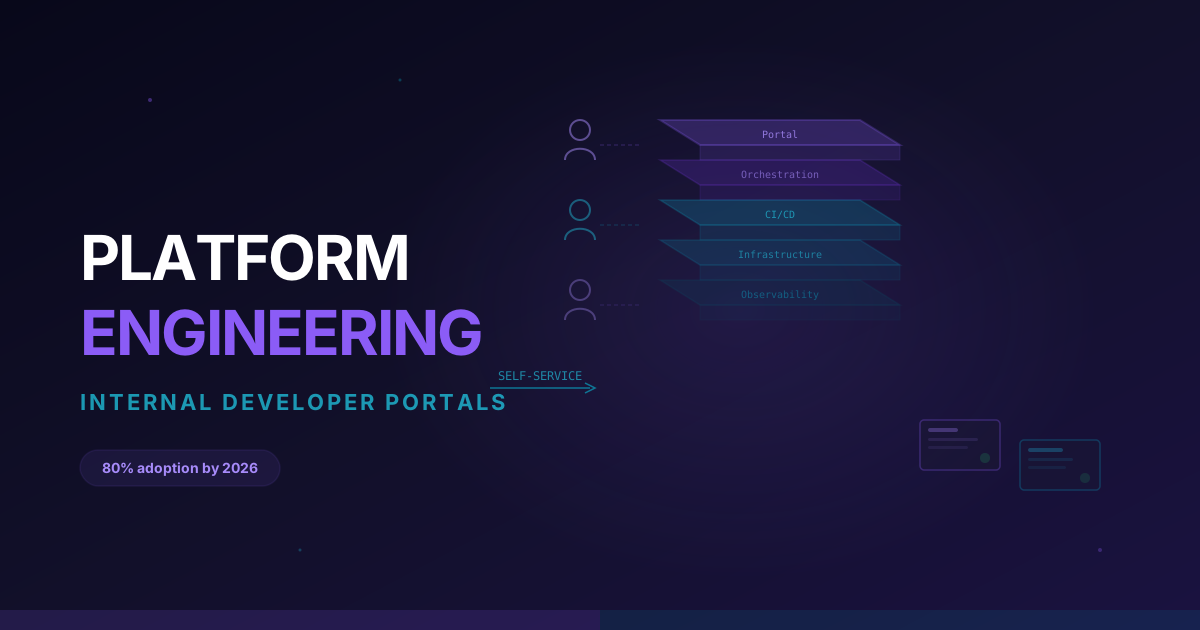
A complete IDP typically consists of five layers:
| Layer | Purpose | Example Tools |
|---|---|---|
| Developer Portal | Self-service UI, service catalog, documentation | Backstage, Port, Cortex |
| Orchestration | Workflow automation, environment provisioning | Argo Workflows, Crossplane, Humanitec |
| CI/CD | Build, test, deploy pipelines | GitHub Actions, Argo CD, Flux |
| Infrastructure | Compute, networking, storage, databases | Kubernetes, Terraform, AWS/Azure/GCP |
| Observability | Metrics, logs, traces, alerts | Prometheus, Grafana, OpenTelemetry |
IDP vs. PaaS
An Internal Developer Platform is not the same as a PaaS like Heroku. PaaS gives you a rigid, opinionated deployment model. An IDP is custom-built for your organization's specific technology stack, compliance requirements, and workflows. It provides the same ease of use as a PaaS but with full control and flexibility.
Why Platform Engineering Is Taking Over
The Developer Experience Problem
A 2025 survey by Humanitec found that developers at organizations without platform teams spend an average of 30% of their time on infrastructure-related tasks. That's nearly two days per week not spent on business logic, features, or innovation.
Platform engineering attacks this directly. By centralizing infrastructure expertise in a platform team and exposing it through self-service tools, individual developers can deploy applications without understanding the underlying complexity.
The Standardization Benefit
Without a platform, every team invents its own deployment process. Team A uses Helm charts. Team B uses Kustomize. Team C wrote a custom shell script. Each approach works in isolation but creates a maintenance nightmare at scale.
An IDP enforces golden paths — standardized, recommended ways to accomplish common tasks. Developers are free to deviate when they need to, but the golden path is so easy that most don't bother. This dramatically reduces inconsistency, security gaps, and onboarding time.
The Scaling Equation
Traditional DevOps scales linearly: more application teams means more DevOps engineers. Platform engineering scales sublinearly: one platform team builds tools that serve many application teams. Organizations with mature platforms report 3-5x improvement in developer productivity per platform engineer invested.
Backstage: The Open-Source Developer Portal
Backstage, originally built by Spotify and now a CNCF incubating project, is the most widely adopted open-source framework for building developer portals. It provides the frontend layer of an IDP — the place where developers go to discover services, create new projects, view documentation, and trigger infrastructure workflows.
Core Features
Software Catalog: A centralized registry of all services, libraries, and infrastructure components in your organization. Each entry has an owner, documentation link, API specification, and dependency graph.
Software Templates: Pre-built templates that scaffold new services with your organization's best practices baked in. A developer clicks "Create New Service," fills in a few parameters, and gets a fully configured repository with CI/CD pipeline, Kubernetes manifests, monitoring dashboards, and documentation — all wired up and ready to deploy.
TechDocs: Documentation-as-code using Markdown files stored alongside the service code. Backstage renders them in the portal, creating a unified documentation hub without maintaining a separate wiki.
Plugin Ecosystem: Backstage has a rich plugin ecosystem. Plugins integrate with Kubernetes, ArgoCD, GitHub Actions, PagerDuty, Prometheus, and dozens of other tools. The portal becomes a single pane of glass for everything developers need.
Backstage Architecture
┌─────────────────────────────────────────────┐
│           Backstage Frontend (React)         │
│  ┌──────────┐ ┌──────────┐ ┌──────────────┐ │
│  │ Catalog  │ │Templates │ │  TechDocs    │ │
│  └──────────┘ └──────────┘ └──────────────┘ │
│  ┌──────────┐ ┌──────────┐ ┌──────────────┐ │
│  │ K8s      │ │ ArgoCD   │ │  GitHub      │ │
│  │ Plugin   │ │ Plugin   │ │  Plugin      │ │
│  └──────────┘ └──────────┘ └──────────────┘ │
├─────────────────────────────────────────────┤
│           Backstage Backend (Node.js)        │
│         ┌──────────────────────┐             │
│         │   Plugin APIs        │             │
│         └──────────────────────┘             │
│         ┌──────────────────────┐             │
│         │   PostgreSQL DB      │             │
│         └──────────────────────┘             │
└─────────────────────────────────────────────┘
           │           │           │
     ┌─────┘     ┌─────┘     ┌─────┘
     ▼           ▼           ▼
  GitHub     Kubernetes    ArgoCD
Building Your First IDP: A Practical Roadmap
Phase 1: Foundation (Months 1-2)
Start with the Software Catalog. Before building any automation, get visibility into what you have. Register every service, library, and infrastructure component in Backstage's catalog. This alone provides enormous value — most organizations can't answer "what services do we run, who owns them, and where are they deployed?" without the catalog.
Define a catalog-info.yaml file for each service:
apiVersion: backstage.io/v1alpha1
kind: Component
metadata:
  name: payment-service
  description: Handles payment processing and subscription management
  annotations:
    github.com/project-slug: myorg/payment-service
    backstage.io/techdocs-ref: dir:.
  tags:
    - python
    - fastapi
spec:
  type: service
  lifecycle: production
  owner: team-payments
  dependsOn:
    - component:user-service
    - resource:postgres-payments
  providesApis:
    - payment-api
Phase 2: Golden Paths (Months 2-4)
Build Software Templates for your most common use cases. Interview your development teams. What do they create most often? A new microservice? A new frontend app? A new data pipeline? Build templates for the top 3 patterns.
A good template should provision:
- A Git repository with scaffolded code and CI/CD pipeline
- Kubernetes manifests with sensible defaults
- A monitoring dashboard
- An entry in the Software Catalog
- Basic documentation
Start With One Golden Path
Don't try to build templates for everything at once. Pick the most common pattern (probably "new microservice") and build an excellent template for that one use case. Get feedback from developers, iterate, and expand to additional patterns once the first one is solid. The goal is adoption, not coverage.
Phase 3: Self-Service Infrastructure (Months 4-6)
Add Crossplane or Terraform controllers to let developers provision infrastructure through the portal. Want a new PostgreSQL database? A Redis cache? An S3 bucket? Developers should be able to request these through Backstage without filing a ticket.
The key: platform teams define the "menu" of available infrastructure with sensible defaults and guardrails. Developers choose from the menu. The platform provisions and manages the lifecycle.
Phase 4: Observability Integration (Months 6-8)
Integrate monitoring and incident management into the portal. Developers should see their service's health, recent deployments, error rates, and on-call schedules without leaving Backstage. Plugins for Prometheus, Grafana, PagerDuty, and OpsGenie make this straightforward.
Measuring Platform Success
Platform teams must measure their impact. Track these metrics:
- Lead time for change: Time from code commit to production deployment. Mature platforms achieve under 1 hour.
- Onboarding time: How long it takes a new developer to deploy their first change. Target: under 1 day.
- Self-service adoption: Percentage of infrastructure requests fulfilled through the platform vs. manual tickets. Target: 80%+.
- Developer satisfaction: Regular surveys. The platform is a product — if your customers (developers) don't like it, it's failing.
- Cognitive load score: Survey developers on how much mental effort infrastructure tasks require. Should decrease over time.
The Build Trap
The biggest risk in platform engineering is building tools nobody uses. Treat the platform as a product. Talk to developers before building. Ship small increments and get feedback. A simple tool that developers actually use beats a sophisticated platform they ignore.
Platform Engineering Career Path
Platform engineering is one of the fastest-growing specializations in tech. Roles are commanding salaries 20-30% above traditional DevOps positions because the talent pool is small and the demand is accelerating.
Skills to develop:
- Kubernetes administration and operator development
- Infrastructure as Code (Terraform, Crossplane, Pulumi)
- CI/CD pipeline design (GitHub Actions, ArgoCD)
- Backstage development (React, Node.js, plugin API)
- API design and developer experience
- Product thinking and stakeholder management
The unique aspect of platform engineering is that it combines deep technical skills with product management. You're not just building infrastructure — you're building a product for internal developers, which requires understanding user needs, measuring adoption, and iterating based on feedback.
Platform Team Structure and Common Anti-Patterns
Team Topology
Platform teams work best as a dedicated product team with 4–8 engineers, reporting to engineering leadership — not under any individual product team. Key roles:
- Platform engineering lead: Owns roadmap, stakeholder communication, and the build vs. buy decisions.
- Platform engineers: Build and maintain the IDP tooling. Mix of backend engineers and senior DevOps engineers.
- Developer experience (DX) engineer: Focuses exclusively on usability — reducing onboarding time, gathering developer feedback, improving the portal UI.
The team size should be roughly 1 platform engineer per 10–15 application engineers. Smaller than this, the platform can't keep up with demand. Larger than this, the team loses focus and builds features nobody asked for.
Anti-Pattern 1: Building Before Validating
The most common platform failure: a team spends 6 months building an IDP before talking to developers. They build what they think developers need, not what developers actually need.
Fix: Run discovery sprints before building anything. Spend two weeks interviewing developers on their biggest pain points. Build the simplest possible version of the top-requested feature. Measure adoption before building the next feature.
Anti-Pattern 2: Mandating the Platform
Forcing developers to use the platform breeds resentment and workarounds. Teams create shadow IT — unofficial scripts and tools that bypass the official platform entirely.
Fix: Make the golden path the easiest path, not the only path. If your self-service database provisioning takes 30 seconds and the manual alternative takes 2 days of tickets, developers will choose the platform without being forced.
Anti-Pattern 3: Treating Platform as Pure Infrastructure
A platform team that only builds infrastructure and ignores documentation, onboarding flows, and developer communication is invisible. Developers don't know what the platform can do or how to use it.
Fix: Invest at least 20% of platform team capacity in documentation, tutorials, and internal communication. Host monthly "platform office hours." Create a Slack channel for platform questions. Treat developer adoption as a metric you optimize for.
Measuring Platform ROI
Platform teams often struggle to justify their existence because the value is diffuse. Track these metrics monthly and present them to leadership:
| Metric | Baseline | 6-Month Target |
|---|---|---|
| Time to first deployment (new engineer) | 3 days | 4 hours |
| Infrastructure ticket volume | 200/month | 50/month |
| Self-service adoption rate | 0% | 70%+ |
| Mean deployment frequency | 2x/week | 5x/week |
Conclusion
Platform engineering represents the maturation of DevOps. Instead of expecting every developer to become an infrastructure expert, it concentrates that expertise into a platform team that builds tools and abstractions for the rest of the organization.
The industry is moving fast. Gartner's prediction of 80% adoption by 2026 reflects what we're already seeing — every mid-to-large engineering organization is either building an IDP or planning to. The teams that start now will have a significant competitive advantage in developer productivity, deployment frequency, and engineering retention.
If you're a DevOps engineer wondering about your next career move, platform engineering is it. The skills you already have — Kubernetes, Terraform, CI/CD, cloud platforms — form the foundation. Add developer experience thinking, Backstage expertise, and product management skills, and you'll be positioned at the leading edge of the industry's direction.
Want to practice this hands-on?
CloudaQube generates complete labs from a simple description. Try it free.
Get Started Free